Introduction
If you’re shopping for outdoor tables, chairs, benches, or railings and you typed “wrought iron vs cast iron”, you’re in the right place. We’ll keep this simple, practical, and focused on what really matters outside: rust resistance, wind stability, repairability, looks, and lifetime cost-so you can choose with confidence. What “wrought” means today: In modern patio furniture, things sold as “wrought iron” are usually mild steel (low-carbon steel) shaped and welded to look traditional. Classic, fibrous wrought iron (made by puddling, with slag “threads”) is largely a heritage material now. For a plain-English primer, see Britannica on wrought iron and Britannica on cast iron.
TL;DR – fast picks
- Coastal or humid climate? Choose mild steel (“wrought”) with hot-dip galvanizing + powder coat (the “duplex” combo), or consider aluminum/316 stainless. See American Galvanizers Association: Duplex Systems and AkzoNobel’s ISO 12944 overview.
- Windy rooftop or exposed deck? Cast-iron table bases are super stable thanks to their mass.
- Want easy repairs over the years? Mild steel is weldable and straightenable; by contrast, cast iron welding is specialist work.
Happy Rattan insight: “If your space is gusty, mix and match: cast-iron base for the table + mild-steel chairs with a strong finish. Stable, serviceable, best of both.”
What does each metal really?
“Wrought” today = mild steel
- What it is: Low-carbon steel that’s bent/rolled and welded into frames.
- Why you care: It’s tough and ductile, so little knocks are fine; if a leg bends, a local metal shop can weld/straighten it easily.
- Historic note: True wrought iron (slag-fibrous) is rare now; mild steel is the modern stand-in for furniture. See Britannica on wrought iron.
Cast iron
- What it is: An iron alloy with ~2-4% carbon that’s poured into sand molds. Designers love it for ornate details and heft (think ultra-stable table bases). The trade-off is brittleness-less happy with sharp impacts and trickier to weld/repair. See Britannica on cast iron and TWI: Weldability of Cast Irons.
Happy Rattan insight: “Cast iron is your heavyweight champ-amazing at staying put. Mild steel is the all-rounder-strong, flexible, and easy to mend.”
Head-to-head for outdoor use
Strength, weight & stability
- Cast iron is very heavy → fantastic wind resistance, fewer tip-overs.
- Mild steel has great toughness and can be repaired if something bends. Welding cast iron requires specialists, preheat, and controlled cooling; it’s doable but not a casual fix. See TWI: Weldability of Cast Irons.
Rust & finishes (the make-or-break topic)
Bare iron/steel will rust outside; your finish system is the real hero:
- Powder coating gives color + barrier protection. Architectural performance tiers you’ll often hear about are AAMA/FGIA 2603/2604/2605 (higher numbers = better UV/fade/chalk resistance). While these are written for aluminum extrusions/panels, many outdoor brands use them as performance benchmarks for coatings on steel furniture. See the FGIA/AAMA Coatings & Finishes portal, FGIA AAMA 2604, and FGIA AAMA 2605.
- Hot-dip galvanizing (HDG) adds a metallurgically bonded zinc layer that protects steel both sacrificially and as a barrier.
- Duplex system = HDG + powder coat. Used together, they often last significantly longer than either alone-provided surface prep is right. See American Galvanizers Association: Duplex Systems and Preparing HDG for Powder Coating (ASTM D7803).
- Environment matters: ISO 12944 rates corrosivity from C1 (very low) up to C5/CX (very high/coastal/offshore). If you’re near salt air, ask which ISO 12944 class your finish targets are. A readable summary is AkzoNobel’s ISO 12944 overview.
[Please read more: How to renovate wrought iron patio furniture]
Happy Rattan insight: “Near the ocean? Ask this exact question: Is the frame hot-dip galvanized before powder coating, and what performance class do you target? That single question filters out 80% of regret.”
Repair & upkeep
- Mild steel: Easy to sand a chip, apply zinc-rich primer, then topcoat to seal.
- Cast iron: Surface rust can be refinished, but cracks in a casting are time-consuming and not always economical to repair (you’ll need a specialist). See TWI: Weldability of Cast Irons.
The big picture in one table
| Factor | “Wrought” (Mild Steel) | Cast Iron |
|---|---|---|
| How it’s made | Bent/rolled + welded | Poured into molds |
| Ductility & repairs | High (easy to weld/straighten) | Lower (brittle; welding is specialist) – see TWI: Weldability of Cast Irons |
| Weight & wind | Medium-heavy; good stability with design | Very heavy; very stable |
| Rust reality | Needs a good finish | Needs a good finish |
| Coastal best practice | Duplex: HDG + powder | High-quality powder is essential; foundry practice and geometry affect options |
| Look & style | Slim frames, custom scrolls | Chunkier, ornate cast motifs |
| DIY touch-ups | Easier | Harder if cracked |
| Lifetime value | Great with duplex + simple care | Great if the coating stays intact; cracks are costly |
Choose by climate & setting (simple matrix)
| Where you live/use | Happy Rattan’s recommendation | Why it works | What to ask the seller |
|---|---|---|---|
| Dry inland patio | Powder-coated mild steel with zinc-rich primer | Good barrier + easy touch-ups | “What powder warranty/UV class is this? (2604-level or better?)” – see FGIA AAMA 2604 |
| Humid/industrial city | Duplex: HDG + super-durable powder | Zinc protects; powder seals & improves UV/fade performance | “Is the frame hot-dip galvanized before powder?” – see American Galvanizers Association: Duplex Systems |
| Coastal/marine | Duplex on mild steel, or switch to aluminum (2605-class) / 316 stainless | Marine air = very high corrosivity (C5/CX) | “Which ISO 12944 class do you design for-C5/CX?” – see AkzoNobel’s ISO 12944 overview |
| Windy rooftops | Cast-iron table base + mild-steel chairs | Mass = stability; chairs remain serviceable | “Powder resin type and outdoor fade/chalk warranty?” – see FGIA/AAMA Coatings & Finishes portal |
Coatings that actually matter (short & practical)
- Powder performance tiers: [FGIA AAMA 2603] (good), FGIA AAMA 2604 (high performance), FGIA AAMA 2605 (superior performance). Again: standards are for aluminum, but widely used as a performance shorthand in furniture specs.
- HDG basics: The zinc coating is metallurgically bonded; it protects steel by sacrificial action and as a barrier. See American Galvanizers Association: Duplex Systems.
- Prep matters: To powder-coat over HDG successfully, follow Preparing HDG for Powder Coating (ASTM D7803) to control adhesion/outgassing.
Happy Rattan insight: “Ask for the stack in one sentence: HDG to ASTM spec + thermal pretreatment + super-durable powder (2604/2605). That’s a grown-up finish.”
Cost, value & sustainability (the lifetime view)
Industry studies peg the global cost of corrosion around US $2.5 trillion (~3.4% of global GDP), and note that 15-35% can be saved with proper corrosion control (smart design + coatings). See AMPP/NACE IMPACT Study. How this plays out on your patio:
- Cast iron can be cost-effective for ornate shapes, but shipping/handling costs more due to weight. If coatings fail in marine air, your refinish/replace cycle shortens.
- Mild steel (“wrought”) may cost more to fabricate for fancy scrolls, yet it’s easy to repair locally. With duplex, service life in tough climates improves dramatically, reducing the total cost of ownership. See American Galvanizers Association: Duplex Systems.
Real-world scenarios
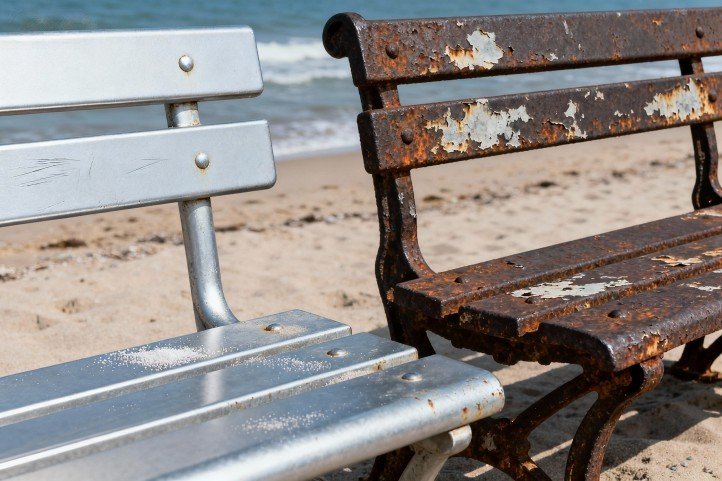
- Beachfront balcony (salt in the air). Choose mild steel with duplex or jump to aluminum (2605-class) / 316 stainless. Ask for a coating system that targets ISO 12944 C5/CX. See AkzoNobel’s ISO 12944 overview and FGIA AAMA 2605.
Happy Rattan insight: “Even the best finish appreciates a simple rinse routine. Water + mild soap every few months = fewer salt deposits, longer life.”
[Please read more: Marine-grade Corrosion Control]
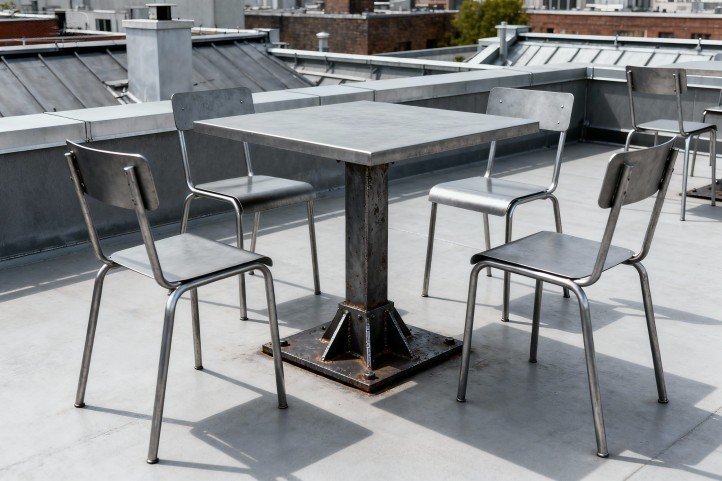
- Wind-prone roof terrace. Use a cast-iron table base for stability, pair it with mild-steel chairs that you can service if they topple.
- Shaded suburban patio (dry). Powder-coated mild steel with a zinc-rich primer is an excellent value. A gentle seasonal clean keeps it looking fresh. For practical care steps, see Interpon (AkzoNobel) Cleaning & Maintenance Guide.
Maintenance that actually works (15-30 minutes)
- Rinse occasionally with low-pressure water; use pH-neutral soap if needed.
- Inspect feet/welds; touch up chips: sand → zinc-rich primer → matching topcoat.
- Keep drain holes clear and avoid constant soil contact (traps moisture/salts).
- Coastal owners: Clean every 3-6 months to remove salt spray. See Interpon (AkzoNobel) Cleaning & Maintenance Guide.
Helpful videos:
- How To Refinish Wrought Iron Patio Furniture?
- Removing Rust & Repainting Metal Patio Furniture
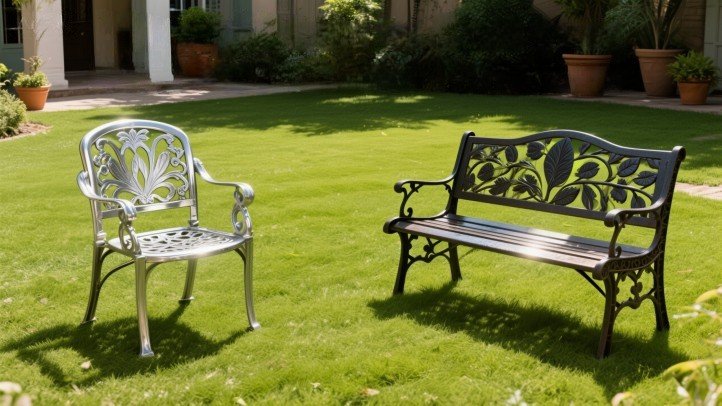
ALT text ideas for your product images: “Wrought iron vs cast iron outdoor chairs-powder-coated mild-steel chair (left) vs cast-iron bench (right) after one coastal season.” “Duplex finish cutaway showing HDG zinc + intermetallic layers beneath powder coat.”
Short tech corner (kept friendly)
- Cast iron: ~2-4% carbon; pours into molds; great for mass and detail, but more brittle than steel. See Britannica on cast iron.
- Historic wrought iron vs modern “wrought”: The old, fibrous metal is largely obsolete; mild steel is today’s practical equivalent in furniture. See Britannica on wrought iron.
- Duplex lasts longer: HDG + powder outperforms either alone for many outdoor scenarios; good prep is essential. See American Galvanizers Association: Duplex Systems and Preparing HDG for Powder Coating (ASTM D7803).
- Standards to recognize: ISO 12944 (environment corrosivity classes) and AAMA/FGIA 2604/2605 (powder performance tiers used as benchmarks in outdoor specs). See AkzoNobel’s ISO 12944 overview, FGIA AAMA 2604, and FGIA AAMA 2605.
Buyer’s mini-checklist (save this)
- Material confirmation: Mild steel or cast iron? Any mixed construction (cast-iron base + steel frame)?
- Coating stack: Powder only, or HDG + powder (duplex)? Is prep aligned to Preparing HDG for Powder Coating (ASTM D7803) to avoid adhesion issues?
- Coastal proof: Which ISO 12944 class is the system designed for (C5/CX)? See AkzoNobel’s ISO 12944 overview.
- Repair & parts: Touch-up kit, foot caps, glides, and accessible welds.
- Warranty & care: Written outdoor warranty + maintenance schedule (cleaning frequency). A good baseline is the Interpon (AkzoNobel) Cleaning & Maintenance Guide.
Happy Rattan insight: “If a seller can’t answer what finish stack they use and what standard it targets, keep shopping.”
Quick conclusion – which should you buy?
If you’re coastal or high-humidity, choose mild steel (“wrought”) with a duplex system (HDG + powder) or go with aluminum (2605-class) / 316 stainless. If you’re wind-exposed, a cast-iron base keeps your table planted. If you value easy, local repairs and long service life, mild steel is your friend-especially with the right finish and a simple cleaning routine. In the debate of wrought iron vs cast iron for outdoor furniture, let your climate and finish system be the tie-breakers.
FAQ
Q1. Which lasts longer outdoors: wrought iron or cast iron?
A. Neither wins by default-the finish system + climate decides. In salty or humid air, HDG + powder (duplex) on mild steel typically outlasts powder-only systems. See American Galvanizers Association: Duplex Systems and AkzoNobel’s ISO 12944 overview.
Q2. Will cast iron crack if it tips over?
A. It can. Cast iron is brittle compared to steel; sharp impacts may cause cracks or chips. Mild steel usually bends rather than breaks and is easier to repair. See TWI: Weldability of Cast Irons.
Q3. What coating should I ask for near the ocean?
A. Ask for duplex: hot-dip galvanizing + a high-performance powder coat, and verify the system is intended for ISO 12944 C5/CX conditions. See Preparing HDG for Powder Coating (ASTM D7803) and AkzoNobel’s ISO 12944 overview.
Q4. Can I stop rust from spreading on a chip myself?
A. Yes: sand to bright metal, apply a zinc-rich primer, then topcoat to seal. Keep surfaces clean-especially in marine air. For frequency and detergents, follow the Interpon (AkzoNobel) Cleaning & Maintenance Guide.
Q5. Is there a quick way to learn refinishing steps?
A. Yes-watch a couple of short tutorials: How To Refinish Wrought Iron Patio Furniture? and Removing Rust & Repainting Metal Patio Furniture.