
Summary
This engineering guide for Outdoor Modular Sofa Systems shows how to keep joints tight for a decade: build a stiff, well-drained aluminum frame, create durable threads in thin sections, specify redundant anti-loosening fasteners, and validate with salt spray, UV, and vibration testing. For real-world layouts and bill-of-materials ideas tailored to Outdoor Modular Sofa Systems, see the inspiration and product pages referenced below: outdoor modular sofa collection.
Why Outdoor Modular Sofas Loosen — and How We Stop It
Outdoor furniture sees wide temperature swings, moisture, salt, UV, and repeated live/dynamic loads (sit-downs, reconfiguration, transport). The fix is systemic: pair a stiff, drainable frame with mechanical + chemical joint locking, galvanic-aware materials, measured torque, and standards-based validation:
- Salt spray for comparative corrosion QA (ISO 9227, latest 2022 update). (iso.org)
- UV/weathering via ISO 4892-2 (xenon arc) or ASTM G154 (fluorescent UV). (iso.org)
- Vibration loosening using DIN 65151 / ISO 16130 (Junker-type transverse vibration). (vibrationmaster)
For layout inspiration as you think in modules, see 7 outdoor sofa ideas.
Design Targets You Can Measure
- Use profile-specific load cases. Include seated loads, plop/impact, reconfiguration cycles, and shipping/stacking scenarios.
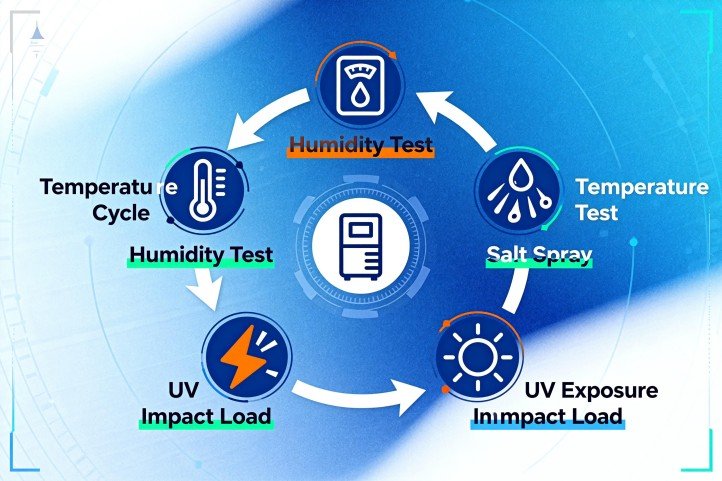
- Translate “10 years” into test exposure. Choose salt-spray hours by coating class (QUALICOAT/ISO), UV exposure hours (ISO 4892-2/ASTM G154), and vibration cycles (Junker/ISO 16130) to represent worst-case usage — these are comparative tests, not direct life converters. (iso.org)
- Define pass/fail up front. Set thresholds for loosening angle/preload loss, first red rust, gloss retention, ΔE, etc., per the chosen standards. (iso.org)
Buyer-facing criteria to bridge engineering and selection: How to choose the right indoor–outdoor sofa.
Frame Architecture: Stiffness, Drainage, and Dissimilar-Metal Hygiene
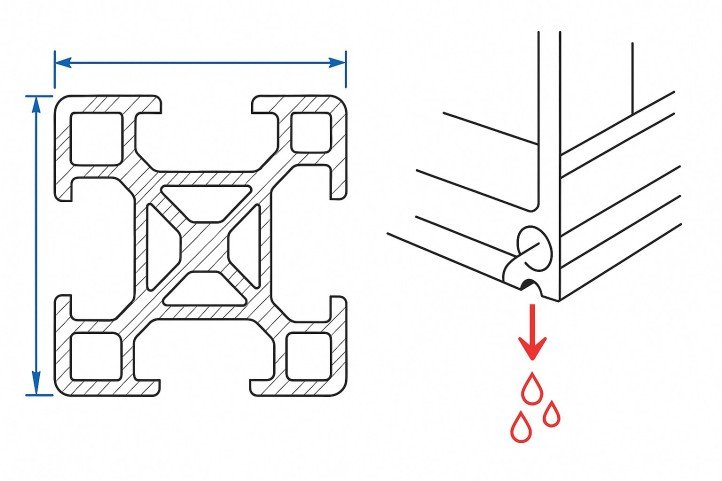
Baseline — Powder-coated 6063-T6/6061-T6 aluminum extrusions with cross-bracing and gusseted corners. Provide drain/vent paths in every closed cavity; isolate stainless-to-aluminum interfaces (bushings, insulating washers, insert nuts) to avoid galvanic couples.
- Coating systems & durability tiers: follow QUALICOAT Specifications for architectural aluminum; use ISO 12944-5 to select paint systems for any complementary coated-steel parts/hardware by corrosivity category. (QUALICOAT)
- Materials overview (aluminum, rattan, rope, teak): Happy Rattan materials hub.
- Brand credentials: About Happy Rattan (15+ years).
- Galvanic compatibility methodology: MIL-STD-889D and AMPP galvanic series guidance. (QuickSearch)
Connectors & Anti-Loosening for Outdoor Modular Sofas: Build Redundancy into Every Joint
Think in two layers:
- Durable threads in thin sections (rivet/insert nuts, press-in bushings).
- Preload retention under vibration/thermal cycling (mechanical lock + threadlocker).
Creating reusable threads in thin aluminum
- Blind rivet nuts / threaded inserts (e.g., Böllhoff RIVKLE®): choose hex-body/knurled styles to resist spin-out; size by grip range and pull-out/shear. (media.boellhoff.com)
Keeping preload under vibration and use
- Mechanical locks: Wedge-lock washers (e.g., Nord-Lock) show superior clamp-load retention in Junker (DIN 65151/ISO 16130) vs. split-lock washers. (Nord-Lock)
- Prevailing-torque nuts: Nylock for moderate temperatures/solvent exposure.
- Chemical locks: LOCTITE® threadlockers — select grade by diameter, service temperature, and disassembly (see selector chart + product hub). (Ellsworth)
Comparison — anti-loosening options (design view)
| Method | Vibration resistance | Reuse | Temp/chemical limits | Needs precise torque? | Typical use |
|---|---|---|---|---|---|
| Wedge-lock washer | ★★★★☆ | High | Excellent | Yes | Module-to-module clamps |
| Nylock nut | ★★★☆☆ | Medium | Nylon limits | Yes | Secondary joints |
| Medium-strength threadlocker | ★★★★☆ | Medium | Per TDS | Yes (wet torque) | Bolts into inserts/rivnuts |
| Split-lock washer | ★★☆☆☆ | High | Good | Yes | Non-critical only |
This section is a practical answer to how to keep modular outdoor sofa joints from loosening under vibration and thermal cycling—use redundant locking (wedge-lock + medium-strength threadlocker) and validate with a Junker test. (vibrationmaster)
See joints in context: browse sofa SKUs & configurations.
Corrosion & Weathering: Protect the Clamp, Not Just the Color
For readers comparing specs around salt spray test outdoor furniture, remember ISO 9227 is a comparative QA method — avoid “hours = years” conversions; set pass/fail by environment class and coating system. (iso.org)
- Salt/chemicals: Use ISO 9227 (NSS/AASS/CASS) for coated hardware/fixtures; specify hours to first red rust by class. (iso.org)
- UV aging: Use ISO 4892-2 (xenon arc) or ASTM G154 (fluorescent UV) to set gloss retention/ΔE for straps, caps, and powder coats. (iso.org)
- Stainless choice: Prefer A4/316 near the coast; A2/304 inland. Trade associations document tea-staining risk & mitigations. (assda.asn.au)
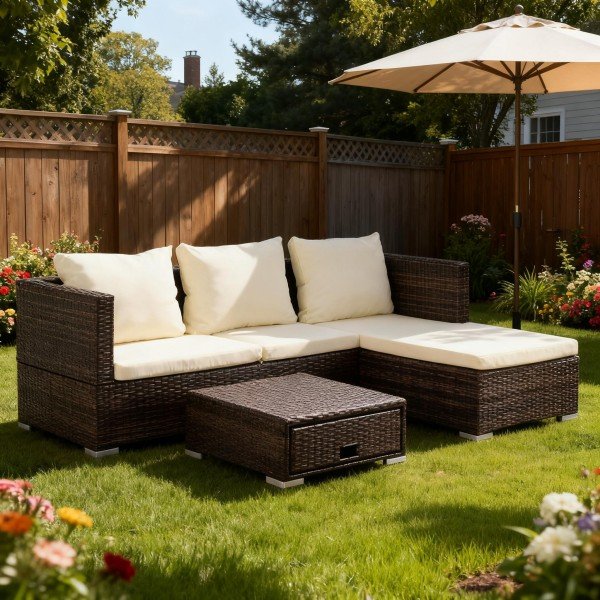
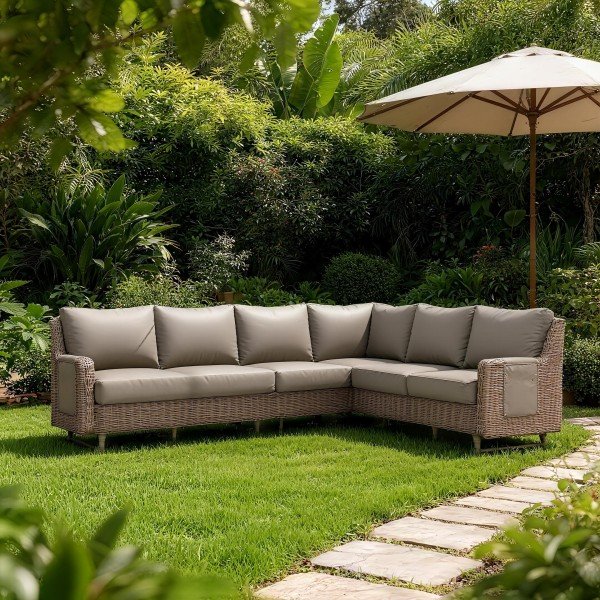
- Powder-coated aluminum example: Representative powder-coated aluminum set to visualize frame/coating pairing.
Tolerances, Assembly & Torque: From Drawing to the Patio
Torque is just a proxy for clamp load; friction scatter dominates. Validate on your real hardware.
- Test torque–preload on your stack per ISO 16047, then publish wet/dry specs and a re-torque policy. (iso.org)
- Specify stainless property classes (A2-70 / A4-70, etc.) per ISO 3506-1 so teams don’t mix low-strength fasteners into structural joints. (iso.org)
Illustrative torque–preload window (validate on your stack; values vary by lube/finish)
| Thread | Substrate | Friction state | Target preload (kN) | Typical torque (Nm) |
|---|---|---|---|---|
| M6 | Al insert/rivnut | Lubed (μ≈0.12–0.15) | 6–8 | 7–10 |
| M8 | Al insert/rivnut | Lubed (μ≈0.12–0.15) | 12–16 | 18–25 |
| M8 | Through-steel boss | Dry (μ≈0.18–0.22) | 12–16 | 25–32 |
Visual SOPs help: Factory & installation videos. For KD shipping/spares policy examples, see the Outdoor Swing category (many KD items share logistics/after-sales patterns used for sofas).

Validation Plan (What to Test Before You Ship)
Together, these checkpoints form an outdoor sofa anti-loosening design validation loop before mass production.
- Vibration loosening — Junker (DIN 65151) / ISO 16130: measure preload loss vs. cycles; compare locking concepts head-to-head. (vibrationmaster)
- Corrosion — ISO 9227 neutral salt spray for comparative QA; set hours to red-rust by coating class. (iso.org)
- UV/weathering — ISO 4892-2 or ASTM G154 to define gloss retention and ΔE thresholds. (iso.org)
- Field serviceability — timed reconfiguration, tool-less checks, spare-kit audit on a pilot install.
- See it in action — Junker test video (Nord-Lock):
Reusable Tables & Checklists
Anti-corrosion stack (quick chooser)
Caption: Environment-specific protection map for Outdoor Modular Sofa Systems.
| Environment | Fasteners | Isolation | Coating | Lab validation |
|---|---|---|---|---|
| Inland, low pollution | A2-70 | PA/PE bushings were needed | QUALICOAT Class 1 | ISO 9227, ASTM G154 |
| Coastal/industrial | A4-70 | Non-conductive washers + sealed interfaces | QUALICOAT Class 2–3 | ISO 9227 ↑ hours; ISO 4892-2 |
| Marine splash/harsh | A4-70 + sealed joints | Dielectric barriers + edge sealing | QUALICOAT Class 3 (+ hard-anodized subs) | ISO 9227 + ISO 4892-2 + periodic field washdown |
Standards & class guidance: QUALICOAT; ISO 12944; ISO 9227; ISO 4892-2 / ASTM G154. (QUALICOAT)
Connector choice matrix
Caption: Joint hardware patterns commonly used in Outdoor Modular Sofa Systems.
| Joint | Best practice | Notes |
|---|---|---|
| Module-to-module clamp | Bolt + wedge-lock washer + medium-strength threadlocker | High vibration resistance; serviceable. (Nord-Lock) |
| Frame corners (thin wall) | Rivet/insert nut + bolt + threadlocker | Hex-body/knurl to prevent spin; seal if needed. (media.boellhoff.com) |
| Quick reconfiguration | Quick-release with positive detent + safety tether | Color-coded ends to avoid mis-assembly. |
Case-Style Evidence You Can Cite
- Salt spray ≠ life prediction. Use ISO 9227 for process control/comparative evaluation; define your own acceptance criteria tied to the environment class and coating. (iso.org)
- Vibration locking. Junker/ISO 16130 testing consistently shows friction-only locks (split washers) lose preload faster than wedge-geometry or adhesives. (vibrationmaster)
- Stainless near the coast. ASSDA and BSSA guidance supports 316 (A4) in coastal sites and proper cleaning to limit tea-staining. (assda.asn.au)
When you’re ready to compare SKUs/configurations: browse products and shortlist candidate frame/connector patterns.
Conclusion
A decade-tight design for Outdoor Modular Sofa Systems follows a closed loop: stiff aluminum frame → redundant anti-loosening → galvanic-aware materials & coatings → measured torque → standards-based validation → serviceability.
FAQ
Q1: What fasteners are best for Outdoor Modular Sofa Systems?
A: For structural joints, use stainless (A4/316 coastal; A2/304 inland) with wedge-lock washers and medium-strength threadlocker for redundancy; verify torque on your stack per ISO 16047.
Q2: Do I need threadlocker if I already use wedge-lock washers?
A: In high-vibration + thermal cycling, yes. Mechanical + chemical locking provides margin, especially into inserts/rivnuts in aluminum. Confirm with a Junker/ISO 16130 comparison on your joint.
Q3: How do I prevent galvanic corrosion between stainless bolts and an aluminum frame?
A: Use isolators (bushings/washers), compatible coatings, sealed edges; follow MIL-STD-889D pairing guidance and AMPP galvanic notes.
Q4: What torque should I use for M6/M8 in aluminum?
A: There’s no universal value — friction (lube/finish) dominates. Establish windows via ISO 16047 torque–tension tests and publish wet/dry specs.
Q5: Which standards should I cite in a 10-year validation plan?
A: ISO 9227 (salt), ISO 4892-2/ASTM G154 (UV/weathering), DIN 65151 / ISO 16130 (vibration loosening), plus QUALICOAT where architectural powder-coat durability is critical.
Q6: How do Outdoor Modular Sofa Systems stay tight after repeated reconfiguration?
A: By combining durable threads in thin aluminum (rivet/insert nuts) with redundant locking (wedge-lock + medium-strength threadlocker), then validating via Junker/ISO 16130 vibration tests and publishing wet/dry torque windows per ISO 16047.