Executive summary
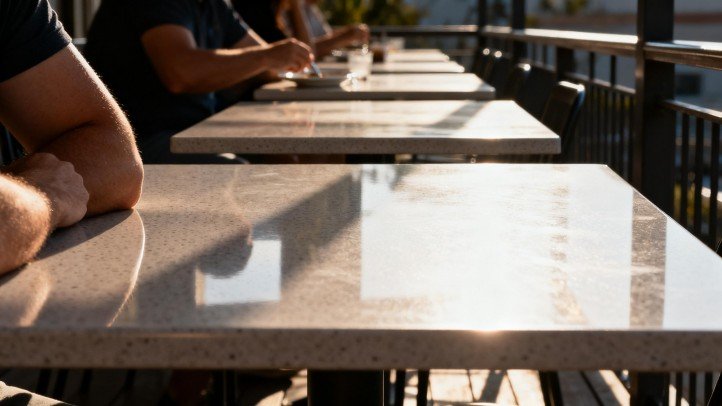
For restaurants, hotels, and contract furniture buyers, the outdoor dining table top you choose will decide sanitation labor, audit outcomes, and guest perception. The winning formula is simple: specify hard, nonporous surfaces detailed with minimal seams, proven chemical compatibility with your disinfectants, and UV stability for true outdoor exposure. This guide translates infection-control best practices into purchasing language, compares mainstream materials, and includes a laminated-card SOP you can train on today. It reflects clean-first-then-disinfect guidance from the CDC and contact-time instructions from the U.S. EPA.
Why your outdoor dining tabletop matters more than you think
Labor: Seam-free, nonporous tops wipe faster and reduce “rework” during rushes. Compliance: Auditors and brand standards increasingly ask whether your surfaces are hard and nonporous, whether your disinfectant is EPA-registered, and whether the labeled contact time is honored. Pin these into your SOPs and training. Use the EPA’s one-pager to reinforce the “keep surface visibly wet for the full contact time” message: Six Steps for Safe & Effective Disinfectant Use.
Internal link → [Read more: Guidance on 316L Stainless]
What makes an outdoor dining tabletop “easy to disinfect”?
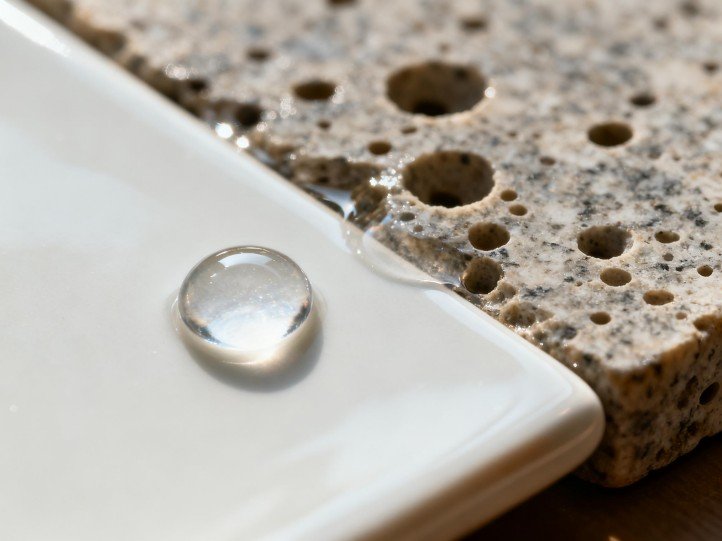
Nonporosity & water absorption
In ceramics, porcelain is defined as water absorption ≤ 0.5% per ANSI A137.1 / ASTM C373 key reason it resists staining and liquid ingress. Ask vendors for the actual absorption test method and value in submittals. See TCNA’s porcelain definition and PTCA certification overview. (Tile Council of North America)
Seams, joints, and grout
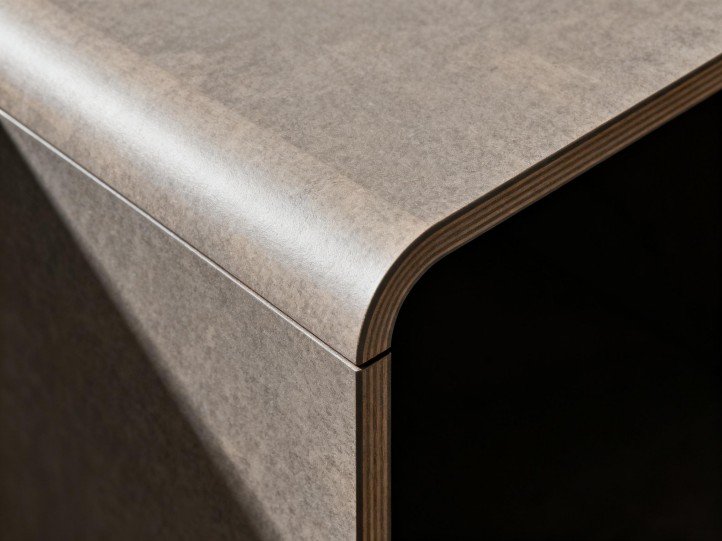
Every exposed grout line or adhesive bead is a soil trap. Prefer one-piece tops or systems that create inconspicuous, adhesive-welded seams with coved edges to remove 90° inside corners. Acrylic solid surface is notable here; DuPont describes Corian® Solid Surface as nonporous with inconspicuous seams designed to avoid crevices that trap contaminants-ideal when you must join pieces or integrate risers. See Corian® technical bulletin and Corian® in Healthcare brochure.
Internal link → [Read more: Guidance on 316L Stainless]
Chemistry compatibility & contact time
Outdoor teams commonly use quats, hydrogen peroxide, and diluted hypochlorite. Regardless of chemistry, efficacy depends on following the label and keeping the surface visibly wet for the full contact time. Reinforce this in training with EPA’s “Six Steps” and product selection via Selected EPA-Registered Disinfectants (List N and others). Stainless steel caution: Hypochlorite (bleach) can pit stainless-especially 304-if left to dry. Rinse and dry promptly after use, and consider 316 near pools or coastlines. See the BSSA guidance on sodium hypochlorite and stainless steel.
UV stability outdoors
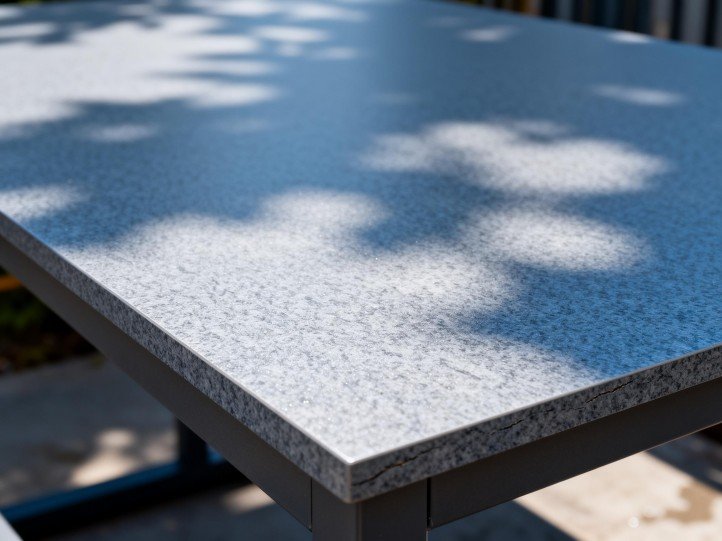
A surface ideal indoors may chalk, yellow, or degrade under the sun. Favor materials and grades explicitly rated for exterior UV exposure-e.g., porcelain/sintered slabs, exterior-grade compact HPL, marine-grade HDPE, and stainless steel- with warranties or data sheets. See Trespa® Meteon® exterior HPL and King StarBoard® marine-grade HDPE.
[Read more: Choosing Outdoor-Rated Colors & Finishes]
Edge design & penetrations
- Outside edges: R5-R8 radii wipe faster (fewer cloth snags).
- Coved transitions: Where tops meet risers, a 10-20 mm cove prevents grime-packed inside corners (great for service stations).
- Fasteners: Conceal or cap; specify stainless; gasket penetrations to avoid grime “rings.”
Material comparison for outdoor dining tabletops
Ratings below are relative (Low/Medium/High). Validate against brand data sheets and warranties.
| Material | Porosity / Absorption | Stain & Chemical Resistance | UV Stability Outdoors | Seamless Options | Disinfection Notes |
|---|---|---|---|---|---|
| Porcelain / Sintered Stone (gauged slabs) | Impervious; porcelain defined as ≤0.5% absorption per A137.1/ASTM C373 | High; resists dyes/oils | High | Large slabs minimize joints; grout (if used) needs upkeep | Excellent for patios/rooftops; request A137.1/C373 data in submittals. TCNA definition. |
| Acrylic Solid Surface | Nonporous, homogeneous | Good resistance to common quats/peroxide; repairable by sanding | Varies by color/grade (confirm exterior rating) | Inconspicuous, adhesive-welded seams; coved edges feasible | Great for seam control; verify outdoor colorfastness and care bulletins. Corian® overview. |
| Compact Laminate (Exterior HPL) | An effectively non-porous surface | Good chemical/impact resistance | Exterior lines are color-stable, weather-resistant | Sheets cut to size; edges must be eased/sealed | Cost-effective and rugged; specify exterior grade like Trespa® Meteon®. |
| Stainless Steel (304 / 316) | Nonporous | Excellent-but rinse after hypochlorite to avoid pitting | High | Fully weldable for one-piece tops | Choose 316 in chloride-rich settings; write rinse/dry into SOP. BSSA hypochlorite guidance. |
| Marine-Grade HDPE | Nonporous polymer | Good to common cleaners; avoid very hot pans/solvents | UV-stabilized for marine sun/salt | One-piece or mechanically fastened | Low maintenance; softer surface shows scuffs. King StarBoard® / PDF. |
| Natural Stone (granite/marble/etc.) | Intrinsically porous (varies) | Requires periodic sealing; some stones etch with acids | Generally UV-stable | Slabs with visible joints | Hygiene depends on sealing & upkeep, not “nonporous.” Natural Stone Institute: Sealing. |
Cleaning & disinfection SOP you can laminate (for hard, nonporous outdoor table tops)
- Dry remove soils. Scrape and discard food residues.
- Clean first (detergent + water), then rinse. Cleaning removes films that reduce disinfectant efficacy; rinse to remove detergent residue. See CDC: Cleaning vs. Disinfecting and When & How to Clean/Disinfect a Facility.
- Disinfect with an EPA-registered product. Use products from Selected EPA-Registered Disinfectants (e.g., List N for SARS-CoV-2 claims). Keep the surface visibly wet for the full labeled contact time.
- Rinse/neutralize if the label requires
- Stainless: If hypochlorite was used, rinse promptly and dry to avoid pitting. BSSA guidance.
- Porcelain / compact HPL / HDPE / solid surface: Rinse if required by the product label; then dry.
- Drying & inspection: Dry with clean microfiber to prevent water spots; quick visual check for stains, chips, loose hardware.
- Frequency
- Between parties: Steps 2-4 (abbreviated is acceptable if not visibly soiled, per label).
- Service rush: Prioritize edges and high-touch zones.
- End of day: Full cycle + log (table ID, time, initials).
Training link (optional): CDC Project Firstline short video – Cleaning? Disinfection? What is the Difference? (add a QR code to your SOP card).
Design details that save minutes per turn
- Edge profiles: R5-R8 outside radii wipe faster with fewer cloth snags.
- Coved transitions: Where tops meet risers, a 10-20 mm cove prevents residue in inside corners (useful on buffet/service counters).
- Hardware hygiene: Conceal fasteners; if exposed, cap them and specify stainless to avoid rust tracks.
- Texture balance: Fine micro-textures improve slip resistance, but avoid deep relief that traps colored sauces and powders.
- Underside drip edge: A simple undercut stops run-back under the table perimeter.
Scenario-based picks
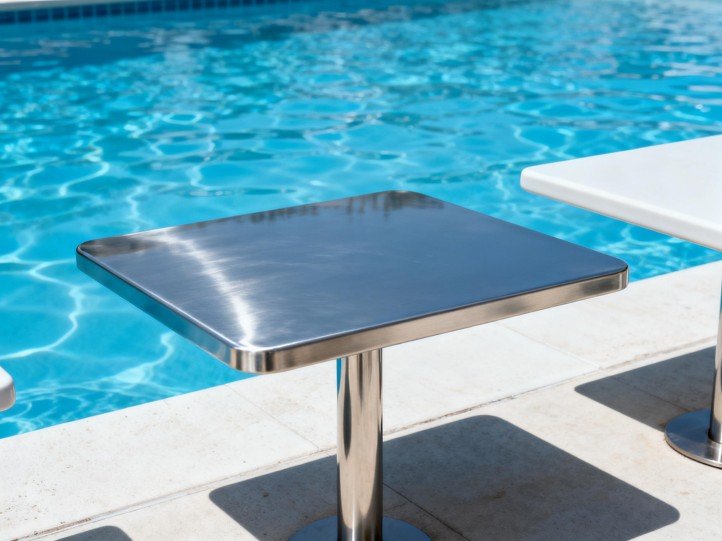
- Pool decks/coastal rooftops: 316 stainless or porcelain/sintered tops on powder-coated bases. If you use bleach, train teams to rinse and dry promptly. BSSA hypochlorite note.
- High-volume patios with frequent reconfiguration: Exterior-grade compact HPL-impact-tough, color-stable, easy to fabricate/replace; mind edge finishing. Trespa® Meteon®.
- Budget-sensitive quick-service patios: Marine-grade HDPE; one-piece, UV-stabilized, low maintenance; accept that it scuffs more than stone/steel. King StarBoard®.
- Design-led hospitality needing sculpted forms: Acrylic solid surface for inconspicuous seams and coved edges; confirm outdoor colorfast grades. Corian® overview.
- Stone look with hygiene priority: Choose porcelain/sintered stone visuals versus natural stone, which requires sealing. TCNA porcelain and Natural Stone Institute: sealing.
Purchase checklist (copy into your RFQ)
- Surface type: hard, nonporous; for porcelain, provide A137.1 / ASTM C373 absorption (≤0.5%) test data. TCNA definition.
- Seam strategy: one-piece or inconspicuous, adhesive-welded seams; avoid exposed grout where possible. Corian® healthcare brochure.
- Edges: Outside R5+; coved transitions where feasible.
- UV stability: Written exterior rating/warranty (e.g., Trespa® Meteon®, King StarBoard®, porcelain slabs).
- Disinfectant compatibility: The SOP cites the EPA contact time, and the vendor confirms compatibility with your List-based products in the selected EPA-registered disinfectants.
- Hardware & penetrations: Stainless fasteners; gasketed penetrations; no raw edges.
- Stain demo: Factory test with coffee/wine/oil (30-minute dwell). After SOP, no visible shadow.
- Repairability: Scratch-blend process (solid surface) or replaceable tops policy.
- Finish: Avoid deep relief textures that trap soils.
- Documentation: Care/maintenance, chemical compatibility sheet, and outdoor warranty.
Cost-of-ownership: why “nonporous + seamless” usually wins
- Fewer chemicals & repeats: Smooth, nonporous surfaces need less product and time to achieve the same hygiene outcome.
- Longer visual life: Materials that resist UV and staining (porcelain/sintered, exterior HPL, stainless, marine-grade HDPE) keep looking open-ready with less buffing or recoating. See Trespa® Meteon® and King StarBoard® claims on weather/UV.
- Training simplicity: One SOP across the patio is easier to teach and audit. The CDC and EPA provide concise materials you can embed in onboarding.
FAQ
Q1: What’s the single most important spec for an outdoor dining table top?
A: Choose a hard, nonporous surface detailed with minimal seams and verified chemical compatibility with your disinfectant. Write the EPA contact time into your SOP. See EPA “Six Steps”.
Q2: Can I use bleach on stainless steel tables outside?
A: Yes, when diluted per label-but don’t let it dry on the surface. Rinse and dry promptly to avoid pitting; consider 316 near pools/coastlines. BSSA guidance.
Q3: Do porcelain or sintered slabs need sealing like natural stone?
A: The slabs themselves are impervious (porcelain ≤0.5% absorption) and generally do not need sealing; grout joints (if any) may need maintenance. Natural stone is different and typically benefits from periodic sealing. See the TCNA definition and the Natural Stone Institute.
Q4: What’s a reliable training video for frontline staff?
A: CDC Project Firstline‘s short explainer: Cleaning? Disinfection? What is the Difference?-perfect to embed as a QR on your SOP card.
Q5: Which materials balance durability, hygiene, and budget for patios?
A: Exterior-grade compact HPL and marine-grade HDPE deliver strong value; for premium durability and stain/UV resistance, choose porcelain/sintered or 316 stainless. See Trespa® Meteon® and King StarBoard®.
Conclusion
If you want a hygienic, low-maintenance outdoor dining table top program, prioritize nonporous materials with minimal seams, codify EPA contact time into training, and demand UV-stable grades for exterior use. In practice, that points to porcelain/sintered slabs, exterior-grade compact HPL, marine-grade HDPE, 316 stainless, and (where sculpted forms and seamless joints are needed) acrylic solid surface with outdoor-rated colors. Lock these requirements into RFQs and SOPs to reduce cleaning minutes per turn, pass audits with less friction, and preserve your patio’s “open-ready” look season after season.