Introduction
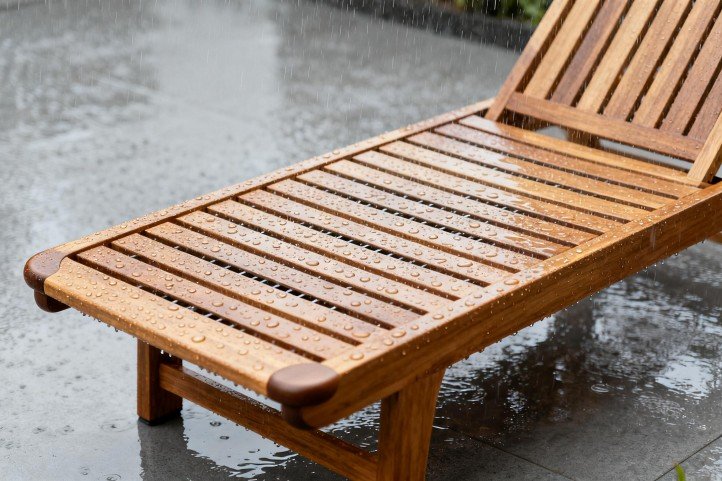
If you manage procurement for hotels, resorts, restaurants, or amenity decks, you’ve likely asked Can Outdoor Wood Furniture Get Wet—and gotten five different answers. Here’s the straight talk: yes, outdoor-grade hardwoods can absolutely live outside, get rained on, and dry out again. But “wet” covers multiple scenarios—brief showers, splash zones by the pool, day-long storms, even standing water—and each demands the right species, drainage-smart design details, and a realistic care plan backed by standards and materials science. For buyers leaning toward premium hardwoods, explore teak outdoor furniture options for commercial settings.
Moisture 101 — How Wood and Water Interact Outdoors
Wood constantly exchanges moisture with ambient air until it reaches equilibrium moisture content (EMC). EMC shifts with temperature and humidity—lower in arid climates, higher in coastal ones—so the same chair behaves differently in Denver than in Miami. During wet/dry cycles, surfaces swell and shrink; hairline checks can appear, especially at end grain. That’s normal in service and usually cosmetic, but unmanaged cycles accelerate wear and shorten finish life.
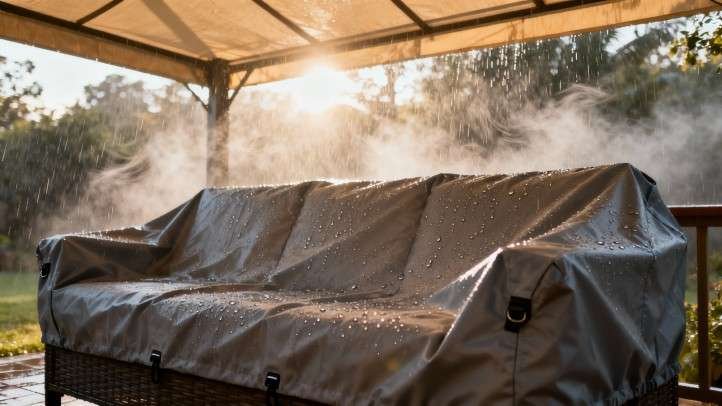
Think in terms of exposure windows. A quick shower that drains off slatted seats is fundamentally different from a day of wind-driven rain plus overnight puddling. The first scenario causes a brief surface wetting; the second saturates joints and end grain, where capillary action can wick moisture deep into fibers. Your goal is to minimize how long water hangs around and to slow the vapor exchange so the whole piece moves less across seasons.
What Finishes Actually Do
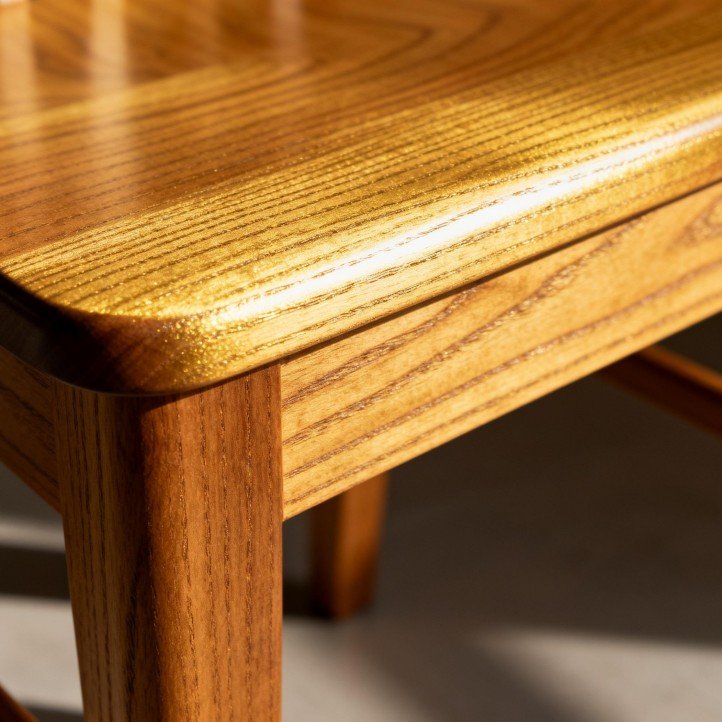
A good outdoor finish does two things: it sheds liquid water and slows vapor exchange so wood moves less with the weather. It can’t hermetically seal wood forever, but it reduces stresses that lead to raised grain and checking. Failures usually begin at edges, joints, and end grain. Translation for buyers: ask vendors how they seal end grain and whether they use penetrating sealers or film-forming systems designed for UV and rain. Simple construction choices—rounded edges, eased profiles, and sealed leg bottoms—let finishes work longer.
Expert angle: Field crews report that the biggest difference between “ages gracefully” and “looks tired by August” is not species—it’s drainage + end-grain sealing + quarterly touch-ups. Budget an hour per set per quarter and you’ll outlast harsher climates with less drama.
For further reading, specifiers often consult the U.S. Forest Products Laboratory for EMC and finishing guidance, which underpins many vendor care sheets.
Species Matter — Teak, Ipe & Others in Commercial Settings
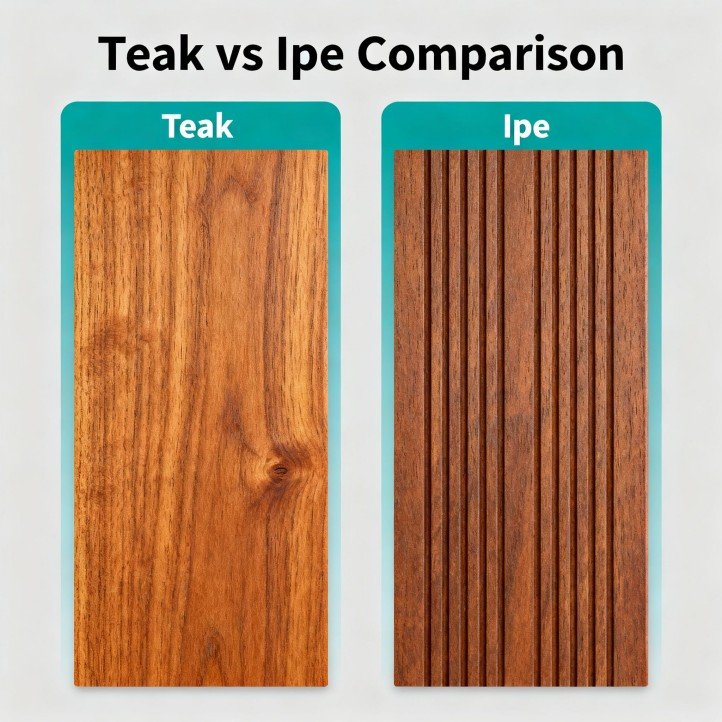
Durability classes (EN 350) rate species from Class 1 (very durable) to Class 5 (not durable) against biological attack. For outdoor furniture that routinely gets wet, Class 1 heartwoods like teak and ipe top the list. Both are dense, naturally oily (especially teak), and proven in marine and exposed environments. That said, “Class 1” doesn’t mean “maintenance-free.” In commercial use, everything benefits from a design that sheds water and a light care cadence.
| Species | Typical Durability (EN 350) | Water Tolerance | Maintenance Cadence (Commercial) | Best-fit Venues |
|---|---|---|---|---|
| Teak (Tectona grandis) | Class 1 (very durable) | Excellent for rain/splash; stable, oily heartwood | Quarterly clean; annual sealer if color retention desired | Poolside lounges, resort dining, rooftops |
| Ipe (Handroanthus spp.) | Class 1 (very durable) | Outstanding; extremely dense and hard | Quarterly clean; UV sealer if maintaining color | High-traffic decks, bars, beachfront venues |
| Eucalyptus (var.) | Often Class 2–3 (varies by species) | Good, watch end-grain sealing | Quarterly clean; consider seasonal top-ups | Cafés, covered patios |
| Acacia (var.) | Typically mid-range | Fair–good with vigilant maintenance | Quarterly clean; protect from standing water | Covered restaurant terraces |
| Western Red Cedar | Class 2 (heartwood) | Good in rain; softer, dings easily | Gentle clean; film-forming coatings for uniform color | Cabanas, private balconies |
Assignments vary by exact species and grade; rely on the vendor’s species sheet and finish system details. When in doubt, ask for the EN 350 reference and finish specs alongside maintenance instructions. For buyers targeting a premium look with predictable wet performance, start with commercial teak collections.
Design Details That Make Wet Conditions a Non-Issue
- Drainage-friendly seats and tabletops. Slats with consistent gaps (≈6–8 mm) shed water fast. Hidden under-rails should not create “gutters”.
- Rounded edges & tapered arms. Sharp edges break film finishes; eased profiles help coatings last longer.
- Raised feet or nylon glides. Prevents wicking from puddles and protects leg bottoms.
- End-grain sealing. Ask how leg bottoms and cutouts are sealed; this is the wood’s “straw” end.
- Breathable, fast-drain cushions. Quick-dry foam + vented covers; pair with sling/rope backs that don’t trap water. See modern rope designs for commercial projects.
For dining and lounge ensembles, consider hybrid frames (powder-coated aluminum) with teak arms/tabletops—structure stays rigid in storms, wood accents bring warmth. Browse outdoor sofas and outdoor dining sets to compare construction details across lines.
Cost-of-ownership tip: Designs that dry down quickly reduce cleaning frequency and mildew claims. Over a 3–5 year horizon, better drainage often beats cheaper coatings in total labor and guest-experience metrics.
Finish & Care — The “Wet-Use” Routine (Simple and Staff-Friendly)
You don’t need to baby commercial furniture, but you do need a cadence. Integrate this into housekeeping or engineering SOPs, and align tasks with pre-opening checklists to ensure they are actually completed.
Quarterly (or monthly in splash zones)
- Rinse & wash with mild soap, soft brush, then rinse. Let air-dry.
- Spot-sand raised grain/checks (120–180 grit) and touch up sealer as needed.
- Hardware check. Tighten stainless fasteners; replace any that show tea-staining.
- Feet & sliders. Confirm glides are intact to avoid wicking from puddles.
Annually (pre-peak season)
Decide on look: golden brown vs. silver patina. For gold, apply a UV-resistant sealer; for silver, clean well and skip oils. Finishes reduce moisture exchange and surface wetting; avoid aggressive pressure washing, which can damage fibers and force water into joints.
Staff refresher video (example):
When to Choose Non-Wood Alternatives (and Where Wood Still Wins)
Choose composites/WPC near splash-pads, kid zones, or venues with constant sprinkler overspray. They shrug off frequent wetting with minimal care. See Plastic Wood Outdoor Furniture for low-touch projects.
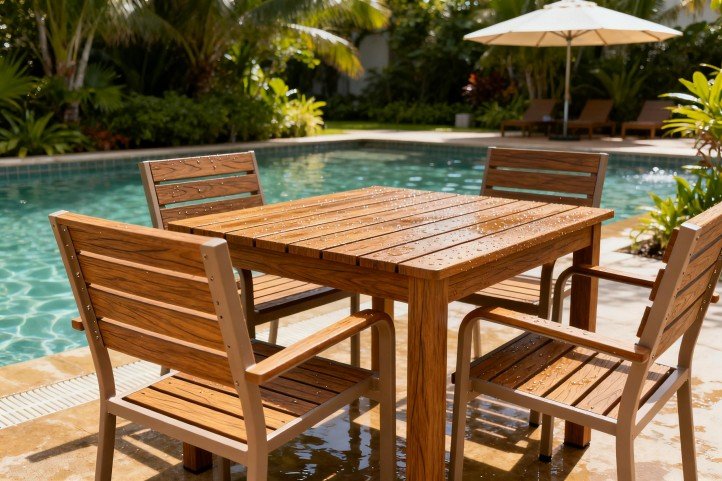
Pick aluminum frames in windy rooftops or salt-spray zones; add teak armrests/table slats for touch-warmth and brand feel. Explore the material overview to mix intelligently.
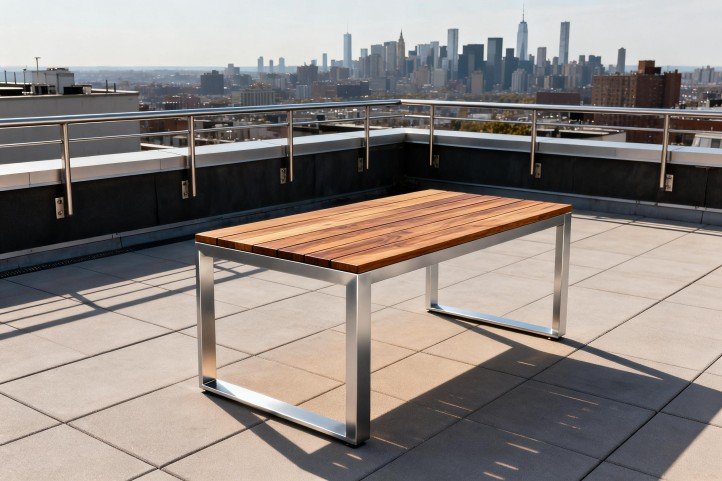
Stick with teak/ipe where guest contact and premium aesthetics drive revenue (signature pool cabanas, resort dining terraces). Durability-classed heartwoods provide the highest confidence margin when wet—provided design and care are right.
Procurement Playbook — Questions to Ask Before You Sign
- Wood species & EN 350 durability class? Request the heartwood class reference.
- How is end-grain sealed? Ask for close-ups or cutaway drawings.
- Finish system details: penetrating sealer vs. film, UV package, and touch-up process (ask for the care sheet).
- Cushion spec: quick-dry foam? Hydrophobic liners? “Waterproof” fabrics typically refer to water-resistant seams.
- Test evidence: UV, salt-spray, or cyclic aging test summaries for coastal installs.
- Field mock-up: Run a one-week rain/hose test on a sample—document dry-down time, any tannin weeping, and hardware spotting (avoid high-pressure on teak).
- Warranty clarity: What’s covered in commercial settings (finish, joinery, frames)?
- Lifecycle parts: Availability of replacement glides, arms, or slats.
Need a fast starting point with vendor support? Get in touch via About Us, or browse Teak Collections.
The Bottom Line on Wet Conditions
Outdoor-grade hardwoods are built for the weather. The winning formula is class-appropriate species (ideally Class 1 in exposed sites) + drainage-smart design + a light, regular care routine. That’s how you keep wood furniture beautiful and profitable in real-world commercial use. In one line for your team: wet-tolerant is not neglect-proof. If you need ready-to-install options, start with teak collections for hotels and resorts or pair aluminum frames with teak touchpoints for a maintenance-balanced spec.
FAQ
Is rain alone a problem for outdoor wood chairs on a hotel terrace?
Short rain is fine for Class 1 hardwoods like teak/ipe that have proper drainage and sealed end-grain. The bigger risks are standing water and trapped moisture under cushions; design and finish quality determine performance more than the rain itself.
Do I need to oil teak to protect it from water?
No. Oils don’t make teak “waterproof” and can attract mildew. If you want to keep the golden color, use a UV-resistant sealer; otherwise, let it weather silver and clean it quarterly.
How do I prevent mildew under seat cushions in a rainy climate?
Specify quick-dry foam, vented cushion covers, and breathable rope/sling backs. Keep drainage gaps clear and add glides so feet don’t wick puddles. Consider rope-back designs in wetter zones.
We’re beachfront—should we avoid wood entirely?
Not necessarily. Many beachfront projects use ipe or teak successfully. Combine smart design (drainage, rounded edges, sealed end-grain) with a light quarterly care plan and consider aluminum frames for structure.
Any quick training resource for seasonal staff?
Yes—share a short maintenance video like the demo embedded above and your vendor’s one-page care sheet. Keep power-washing off the list to protect fibers and finishes.
References (Authoritative)
- U.S. Forest Products Laboratory (FPL) — EMC data, finishing, and moisture guidance.
- Durability & Rot Resistance of Wood — overview (The Wood Database).
- Teak — species profile (The Wood Database).
- Ipe — species profile (The Wood Database).
- British Woodworking Federation — EN 350 guidance for specifiers.