
Introduction: Seating density is a revenue lever
For hotels, restaurants, and cafés (HORECA), every additional safe seat at peak translates into higher revenue per available floor area (RevPAF) and revenue per seat (RevPS). Functional seating-especially stackable outdoor chairs and folding chairs-gives you elasticity: add seats in minutes when the queue forms; pull them back just as fast when demand dips. When screening models, use contract-grade baselines such as the ANSI/BIFMA X5.4 public and lounge seating standard and the European EN 581 outdoor furniture series.
What “functional design” means for HORECA seating
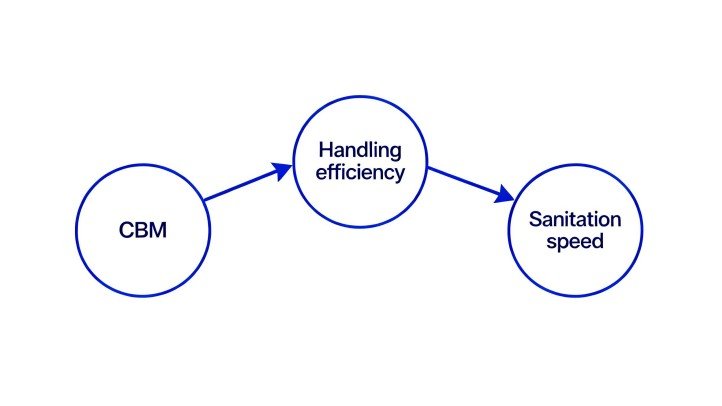
The three KPIs that matter: CBM, handling efficiency, and sanitation speed
- CBM (cubic meters) in storage/stack: Calculate as stack footprint (L×W) × stack height. Lower CBM per 10-20 chairs = more “seat bank” in the same BOH room.
- Handling efficiency: Seats deployed per person per minute (SPPM). Chairs that stack straight on a dolly or load onto a cart compress setup time.
- Sanitation speed & compatibility: Surfaces must tolerate quats or diluted bleach; finishes should resist alcohol streaking and UV. Follow label contact times for EPA-registered disinfectants (List N) and avoid residue build-up that can irritate skin; general cleaning principles are outlined by the CDC.
[For more information, please read: Outdoor furniture cleaner selection guide]
Quick formulas you can use
- Burst capacity (extra peak seats) = Target peak seats – current seats.
- Weekly incremental revenue ≈ : Burst capacity × peak turns × average check × operating days/week.
- Payback period ≈ : Total chair + cart spend / weekly incremental revenue.
Material & form-factor showdown
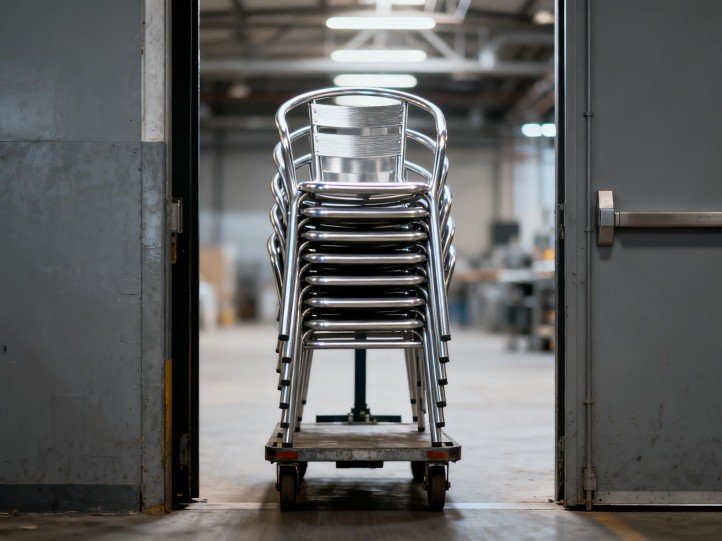
Stackable aluminum chairs (powder-coated Al)
Why operators like them
- Lightweight vs. steel, stable stacks, and excellent outdoor survivability when powder-coated. Coastal sites should confirm coating performance using salt-spray references like ISO 9227 (neutral salt spray) or ASTM B117 and ask vendors for hours-to-failure data.
- CBM: Tubular frames with slim arms typically nest tighter; 10 chairs often stack under a standard doorway height, depending on geometry. Specify stack height in mm/in and insist on a verified CBM per 10 units from the supplier.
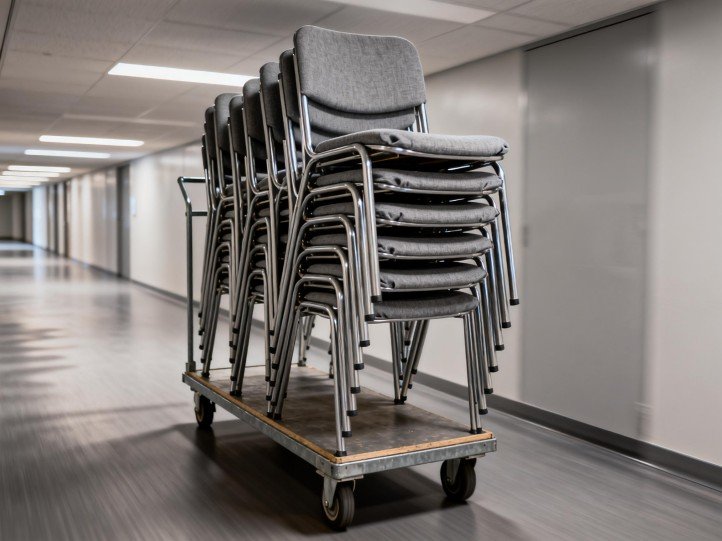
- Handling: With a universal stacking dolly, one staffer can move 8-12 chairs at once on smooth ground (watch thresholds/ramps). See a short operating pattern in this stacking chair dolly demonstration.
- Sanitation: Most quality powder coats tolerate quats and alcohol wipes; avoid prolonged exposure to aggressive alkalis or over-concentrated bleach. Confirm tolerance with your finisher’s data sheet or a certification scheme such as QUALICOAT.
[For more information, please read: Powder coating grades and outdoor weather resistance]
Stackable polypropylene (PP) chairs
Why operators like them
- One-piece shells are easy to wipe; the color is in the material (no paint), which hides scratches.
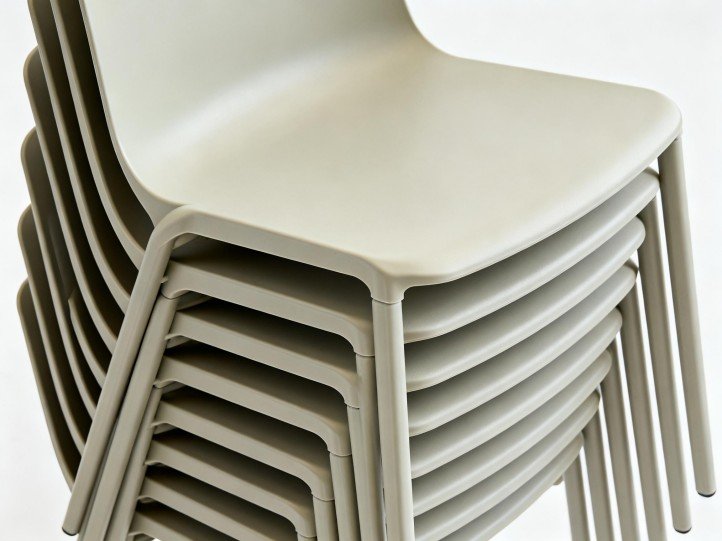
- CBM: Shell geometry (“nesting angle”) and leg taper govern how tightly a stack compresses. Some commercial PP chairs stack extremely high on dollies-e.g., Global Furniture Group’s Popcorn line stacks up to 34 high on a dolly; use this as a screening benchmark when you evaluate designs (Global Popcorn).
- Handling: Add tie-straps when crossing ramps; specify non-marring feet.
- Sanitation & compatibility: PP generally handles diluted bleach and quats, but stress cracking can occur with harsh solvents or high concentrations. Cross-check a PP chemical compatibility chart when selecting detergents/disinfectants and follow EPA List N label guidance for dwell times.
Folding chairs (steel or resin; padded or unpadded)
Why operators like them
- Explosive “burst seats”: the fastest way to double capacity for events and weekends.
- CBM: Ultra-thin folded profiles allow dense vertical storage on high-capacity carts-common solutions carry 40-50 folding chairs per cart; see category examples like MityLite chair carts.
- Handling: One person can wheel an entire bank of folding chairs from BOH to the terrace and fan them out along pre-taped marks-high SPPM with minimal training.
- Sanitation: Focus on hinge/knuckle areas; use a brush + spray + wipe + rinse SOP so residues don’t accumulate in pivot points.
[For more information, please read: Quick Checklist for Event Catering]
Side-by-side comparison (typical operator-level metrics)
Note: Values below are indicative ranges to guide screening; verify exact specs and certifications with the manufacturer (ask for BIFMA/EN or internal test records).
| Item (10 chairs) | Stackable aluminum | Stackable PP | Folding chairs |
|---|---|---|---|
| Typical net weight/chair | 3.5-5.5 kg | 3.2-4.8 kg | 2.7-4.5 kg |
| Stack height (10 pcs) | ~105-135 cm | ~95-130 cm | ~18-30 cm (folded thickness ×10) |
| CBM / 10 pcs (stacked) | 0.30-0.45 m³ | 0.28-0.42 m³ | 0.20-0.32 m³ |
| Move per trip (with dolly/cart) | 8-12 | 10-16 (high-nest shells) | 40-50 (cart) |
| 60-sec wipe-down feasible? | Yes (smooth frames) | Yes (one-piece shell) | Yes (watch hinges) |
| Outdoor durability focus | Powder coat + fasteners | UV stabilization | Hinge corrosion/feet |
| Code/standard references | BIFMA X5.4; ISO 9227 | BIFMA X5.4 | BIFMA X5.4 |
High-density layouts that don’t kill service flow
Aisle widths, turning space, and egress reality
- Keep primary circulation paths ≥ 36″ (915 mm) clear to respect ADA accessible route guidance; provide 60″ (1525 mm) diameter or equivalent T-turn spaces where servers or guests need to turn wheelchairs-see the U.S. Access Board’s Chapter 4 guide.
- For egress aisles serving table seating, fire codes often reference 36-42″ minimum, depending on seat count and configuration; confirm with your local authority and consult NFPA 101 (Life Safety Code) or your jurisdiction’s adopted code.
- Mark cart paths from BOH to the terrace to avoid bottlenecks during rapid seat deployments.
Storage engineering: turn BOH corners into “seat banks”
- Measure doorways, elevator cabs, and turns-your stack height must clear the shortest path to the terrace.
- Rack vertically where possible; label safe max stack height; use straps and toe-boards.
- Move with the right dolly: stacking-chair dollies for nested chairs; vertical folding-chair carts (e.g., MityLite chair carts) for 40-50 capacity to minimize trips.
Sanitation SOPs by material (60-second cycle targets)
Shared rules of thumb
- Use EPA-registered disinfectants appropriate for hospitality surfaces; respect label contact times and rinse steps to prevent residue build-up.
- For routine cleaning (no illness), detergent + water often suffices; sanitize more aggressively during outbreaks or after known contamination per CDC cleaning & disinfection guidance.
Aluminum (powder-coated)
- Daily: microfiber + neutral cleaner → rinse → dry.
- Disinfect: quats or 70% alcohol; avoid strong alkalis/over-concentrated bleach. Confirm powder-coat chemical tolerance with the finisher; for coastal hotels, request salt-spray test data (ISO 9227 / ASTM B117 hours).
Polypropylene (PP)
- Daily: neutral cleaner; soft brush for textured shells.
- Disinfect: diluted bleach (per label) or quats; check PP chemical compatibility and avoid strong solvents that can trigger stress-cracking.
Folding chairs
- Focus on hinges: spray, brush, wipe, and dry so residues don’t gum up pivots; the EPA’s residue methods explain why proper rinsing matters.
[For more information, please read: Outdoor furniture cleaner selection guide]
The business case: from CBM to cash
Simple ROI model you can share with finance
- Burst seats added = Target peak seats – current seats
- Weekly incremental revenue ≈ Burst seats × peak turns × average check × open days
- Payback period ≈ Total investment / weekly incremental revenue
Scenario examples (illustrative)
| Site | Current seats | Target at peak | Burst seats | Avg check | Peak turns | Open days/wk | Weekly uplift | Capex (chairs+carts) | Payback |
|---|---|---|---|---|---|---|---|---|---|
| City café patio | 38 | 62 | 24 | $18 | 1.8 | 6 | $466 | $2,900 | ~6.2 wks |
| Beach hotel bar | 68 | 100 | 32 | $24 | 1.6 | 6 | $737 | $5,200 | ~7.1 wks |
| Event-heavy bistro | 52 | 92 (w/folding) | 40 | $20 | 1.5 | 5 | $600 | $3,600 | ~6.0 wks |
Mini case studies (anonymized)
Case A – City Café: 38 → 62 seats in 12 minutes
- Switch: PP stackables + two dollies; pre-taped terrace grid.
- Results: stacks of 12 moved in two trips; aisle kept ≥36″; sanitation in one pass with quats.
Case B – Beach Hotel: salt-air proofing with aluminum stackables
- Switch: powder-coated aluminum chairs; vendor supplied salt-spray test hours and hardware spec (referenced to ISO 9227 / ASTM B117).
- Results: reduced rust claims and faster nightly wipe-downs.
Case C – Event Bistro: folding chairs for weekend surges
- Switch: two 50-chair vertical carts staged in the BOH hallway; 80 chairs deployed in ~6 minutes with two staff (category example: MityLite chair carts).
- Results: predictable event-weekend setup, minimal storage footprint.
Deployment checklist (print-ready)
- Measure BOH → terrace path (min. doorway height/width, ramp slopes).
- Choose stackable outdoor chairs and/or folding chairs by CBM, handling, and sanitation.
- Order dollies/carts + straps and floor-protecting feet.
- Mark service aisles (≥36″) and turning space; validate egress with local code (see ADA route guidance and your jurisdiction’s NFPA adoption).
- Train staff on the 60-sec sanitation cycle (use EPA List N).
- Pilot on a peak evening; time deployment and teardown; iterate.
FAQ (People-Also-Ask ready)
Q1. How many stackable outdoor chairs can one person move at once?
A. With a proper stacking-chair dolly, 8-12 chairs per trip is common on flat, unobstructed routes; for folding chairs, a vertical cart lets one person move 40-50 at a time (category example: MityLite chair carts).
Q2. What is a good CBM target per 10 chairs for BOH storage?
A. Aim for ≤0.35-0.40 m³ per 10 for everyday restaurant chairs; folding chairs on vertical carts can beat that because they store as thin profiles. Validate with the actual stack footprint × height for your chosen model.
Q3. Are polypropylene stackable chairs safe with bleach or quats?
A. Generally, yes, when properly diluted and rinsed; PP resists many disinfectants, but harsh solvents or over-concentration can cause stress cracking. Confirm with a PP chemical compatibility chart and follow the directions on the EPA List N label.
Q4. Do folding chairs scratch deck or tile surfaces?
A. They can if the feet are made of hard plastic or are worn. Specify soft, non-marring feet and keep them clean. Add temporary runners on wood decks.
Q5. Aluminum vs. PP-what lasts longer in coastal hotels?
A. Both survive outdoors, but powder-coated aluminum with quality fasteners typically wins near salt air, provided the coating system has good salt-spray performance (request hours per ISO 9227 / ASTM B117 from the vendor). PP shells are robust, but UV stabilization and metal fasteners still matter.
Conclusion: Make elasticity your new habit
If you operate a terrace or pool bar, the fastest path to higher RevPAF is elastic capacity. Stackable outdoor chairs and folding chairs minimize CBM in storage, maximize handling efficiency during peaks, and keep sanitation cycles short-without choking service aisles or compromising compliance. Start with a timed pilot on a busy evening, measure SPPM and payback, and scale what works.