Introduction
If you’re tight on floor space or operating in venues where bulky bases aren’t welcome, you still have safe, standards-aware options. This guide explains how to secure a patio umbrella without a base, maps methods to wind thresholds, and sets clear rules for when to close the canopy to protect guests and equipment. We reference the U.S. Consumer Product Safety Commission (CPSC) safety alert on wind-borne umbrellas, ASTM standards for market/beach umbrellas, and the Beaufort/NWS wind scale so your decisions align with industry practice—not guesswork.
Quick internal resources: browse our commercial-grade patio umbrellas or request a quote to spec sleeves, deck plates, or railing-compatible masts.
Treat wind as your primary design input
Consumer injuries from wind-borne umbrellas are well documented by the CPSC, which urges users and providers to follow labeling and safe operating practices (close and secure in wind, don’t leave open and unattended). For market (patio) umbrellas, ASTM F3512 defines wind safety/durability test methods; for beach umbrellas, ASTM F3681 establishes anchor performance to prevent detachment—its “anchor thinking” is useful even off the beach.
To translate this into operations, use the Beaufort (NWS) wind scale. As a practical line in the sand, by Beaufort 6 (25–31 mph), “umbrella use becomes difficult.” Many operators close proactively around Beaufort 4–5 (13–24 mph), because gusts, not just averages, drive incidents.
Key takeaways for your team:
- Build a close-canopy SOP triggered at ~B4–B5 (13–24 mph) and earlier if gusty.
- Never leave umbrellas open and unattended; strap and cover when not in use.
- Validate installation hardware and torque during daily setup.
Six base-free ways to secure a patio umbrella (choose by site conditions)
The table compares permanence, wind policy, skills, and pros/cons. Wind values below are operational ceilings (when to shut), not survival claims with the canopy open.
| Method | Best for | Permanence | Tools/Skill | Operational ceiling (close by…) | Pros | Considerations |
|---|---|---|---|---|---|---|
| Deck/Balcony Railing Clamp | Balconies, roof decks, tight walkways | Non-permanent | Basic hand tools | B4–B5 (≤20–24 mph) | No floor drilling, frees floor space; fast install | Check railing thickness/shape; rigid guardrails only; add under-table stabilizer if possible. |
| Under-table clamp + through-table support | Dining tables w/ umbrella hole | Non-permanent | Wrenches/measure | B4–B5 | Two support points cut sway; zero floor footprint | The table must be rigid; use a proper grommet/cup to protect the tabletop. |
| In-ground sleeve (concrete footing) | Lawns, planters, permanent patios | Permanent | Digging, rebar/concrete | B5 (≤24 mph) typical ops | Clean look; highest structural stability | Permit/utility checks; respect concrete cure times before loading. |
| Bolt-down base plate to deck/slab | Timber decks, concrete pads | Semi-permanent | Drilling/anchors | B4–B5 | Low profile; serviceable | On timber, anchor to joists (not just boards); on concrete, use rated anchors & verify torque. |
| Tie-downs with guy lines | Events, turf, and interim shading | Temporary | Ground stakes/lines | B4 (≤13–18 mph) | Ultra-portable, low CAPEX | Trip hazard; not suitable in crowded egress paths; monitor gusts. |
| Counterweights (sandbags/DIY concrete) | Rentals, pop-ups, no drilling | Temporary | Basic tools | B4 (≤13–18 mph) | Cheap, quick, flexible | Still “weight-based”; position low & symmetric; lock casters. |
Pro buyer tip: When comparing umbrellas, request any ASTM test documentation (F3512 for market umbrellas). For permanent installs, spec sleeves or plates instead of relying on ballast. See patio umbrellas for compatible masts and hardware.
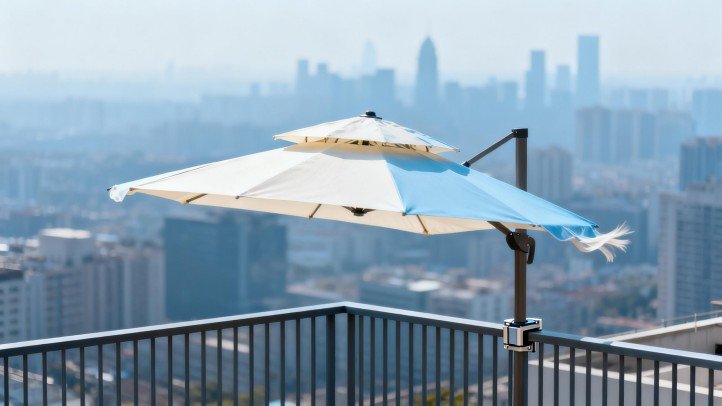
Method 1 — Deck/Balcony Railing Clamp (no floor drilling)
When to use: Apartments, condos, rooftop cafés where floor penetrations are prohibited and space is at a premium.
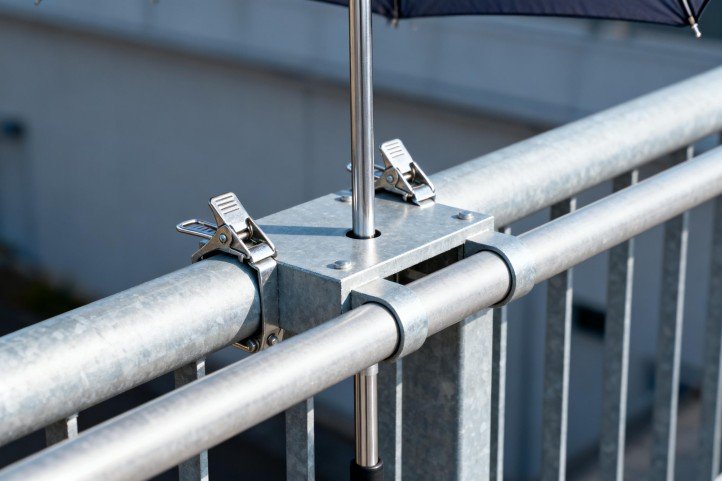
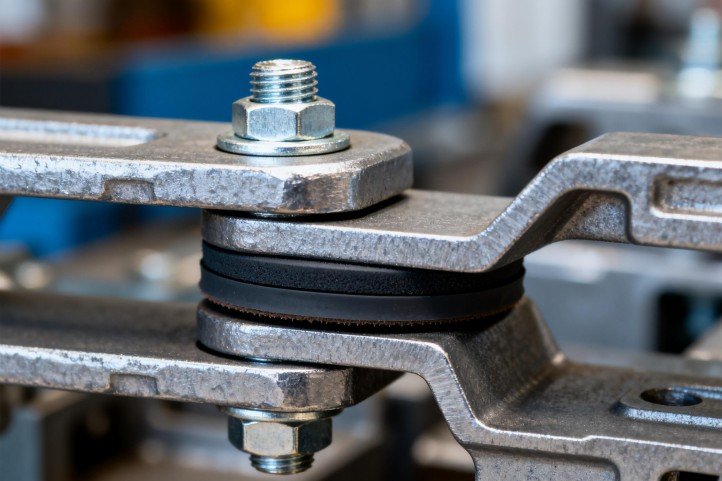
Why it works: A clamp grips the railing; the pole sits in a receiver with set screws. Some systems clamp top & bottom or pair with an under-table receiver, creating two support points that reduce sway.
Steps (10–20 minutes):
- Measure railing thickness/shape and pole diameter.
- Fit rubber shims to protect the finish; level the receiver vertically.
- Tighten clamps evenly to avoid twist.
- Insert pole; snug set screws; verify rotation/tilt.
- Add a short safety tether to a fixed point as a fail-safe.
Helpful videos:
- DIY railing mount build — How to Mount a Sun Umbrella on a Deck Railing (YouTube)
- Rail-EZ clamp overview — quick install (YouTube)
Operations: Close by B4–B5 or sooner if gusty.
Method 2 — Under-table clamp + through-table support
When to use: You already have a table with an umbrella hole and want zero floor footprint.
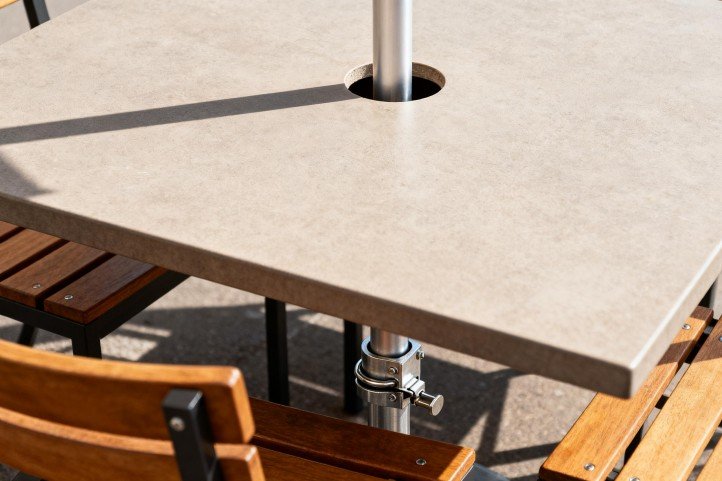
Why it’s effective: Passing the pole through the tabletop shortens the lever arm above the lower support, reducing the bending moment at the clamp. Add a grommet/cup to protect the hole and a below-table receiver to lock the pole mid-height.
Steps:
- Fit protective grommet; 2) Install an adjustable receiver beneath the tabletop; 3) Pass the pole; 4) Tighten and verify verticality and clearances.
Procurement: Explore patio umbrellas sized to common table holes (38–48 mm) or request a quote for adapters.
Operations: Close by B4–B5.
Method 3 — In-ground sleeve (cleanest look & highest stability)
When to use: Resorts, cafés, private gardens — anywhere you want a permanent, clutter-free install.
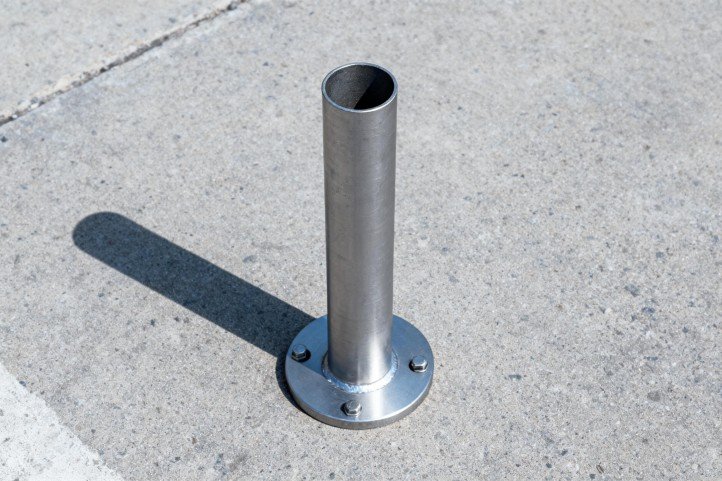
What it is: A galvanized sleeve/spigot set in concrete, flush with grade. After the cure, the mast drops in and locks.
Steps (summary):
- Mark utilities; excavate to spec; compact a gravel base.
- Insert sleeve; brace perfectly plumb.
- Pour concrete; cure fully (per mix and temperature) before loading.
- Fit spigot; secure mast; perform load/tilt checks.
Helpful videos:
-
- In-Ground Mount Installation — Frankford (YouTube)
- Install a cantilever umbrella using an inground fitting (YouTube)
Reference install guides:
- Instant Shade Socket & Sleeve instructions (PDF)
https://www.instantshadeumbrellas.com.au/wp-content/uploads/2023/04/Socket-and-Sleeve-Install-Instructions-2018-2.pdf
Operations: Even with a sleeve, close by ~B5 unless your manufacturer validates higher operating limits for your exact model/site.
Method 4 — Bolt-down base plate (deck or concrete)
When to use: You need a low-profile solution on timber decks or concrete pads without a movable base.
Key points:
- Timber decks: Bolt to joists (not just boards); add backing plates between joists if needed.
- Concrete: Use rated anchors; vacuum dust; set to prescribed embedment; verify torque.
- Verticality matters: Plumb the spigot before final tightening to avoid eccentric loads.
Reference instructions:
- Shadowspec SU4 installation manual (surface plate to concrete) (PDF)
https://help.shadowspec.com/hubfs/SU4%20Installation%20Manual.pdf
Operations: Close by B4–B5; gusts → close immediately.
Method 5 — Tie-downs with guy lines (events & interim shade)
When to use: Short-term/turf setups where ground stakes are allowed.
How: Three or four low-angle guy lines to screw-in/spiral anchors stabilize the mast; add a short lanyard to the pole sleeve. Mark trip hazards with flags in public walkways.
Operations: Keep to B4 (≤13–18 mph) and close at the first sign of gusts. This is a temporary solution.
Method 6 — Counterweights without a “traditional base”
If timing, rental constraints, or CAPEX limit your options, sandbags or a DIY concrete bucket with wheels can tame light breezes. Position weights low and symmetric; strap the pole; keep casters locked on level ground.
DIY videos:
- Umbrella stand for ground (concrete) (YouTube)
Wind policy & compliance (the most important section you’ll implement)
- CPSC safety alert: Airborne umbrellas have caused lacerations, impalements, and even deaths. Use visible labeling, close in wind, and stow when storms approach. (CPSC Safety Alert PDF)
https://www.cpsc.gov/s3fs-public/SafetyAlert_3000_BeachUmbrellas_052024.pdf - ASTM F3512 (market umbrellas): Establishes wind safety/durability test methods; request documentation from suppliers when comparing products.
https://www.astm.org/f3512-21.html - ASTM F3681 (beach umbrellas/anchors): Formalizes anchor performance to prevent detachment; the anchor-validation mindset applies whenever you replace a heavy base with structure.
https://www.astm.org/f3681-24.html - Beaufort/NWS guidance: At B6 (25–31 mph), “umbrella use becomes difficult.” Build your SOP to close by B4–B5. (NWS Beaufort chart PDF)
https://www.weather.gov/media/iwx/webpages/skywarn/Beaufort_Wind_Chart.pdf
Printable SOP (use internally):
- Forecast check daily; if B4+ likely → brief staff.
- Setup: torque-check clamps/bolts; verify verticality and clearances.
- Operations: never leave umbrellas open unattended; if guests leave, close & strap.
- Escalation: B4–B5 sustained or any gusty front → close all; B6 or storm watch → stow.
- After-action: log wind, interventions, and any wear (stretched fabric, loose fasteners).
Two step-by-step options you can hand to installers
A) Non-destructive combo: Railing clamp + under-table receiver
Tools: hex keys, level, tape, protective shims.
Steps:
- Fit clamp to rigid railing (verify thickness compatibility).
- Level and tighten evenly; add rubber shims.
- Pass the pole through the tabletop hole (grommeted) to the under-table receiver; tighten.
- Verify clearance to knees/chairs; add a short safety tether.
Quality checks: Receiver set screws fully engaged; pole vertical within ±1°; canopy opens without scraping; tether attached.
B) Structural: In-ground sleeve or bolt-down plate
Tools: digger or hammer drill, anchors/rebar, level, torque wrench, epoxy (as specified).
Steps:
- Locate utilities; mark hole pattern or footing.
- For sleeves: set sleeve plumb; pour concrete; respect cure time before loading.
- For plates: place plate; drill holes; clean dust; set anchors to embedment; torque to spec.
- Fit spigot, mount mast, strap canopy; perform tilt/load test.
Quality checks: Plate/sleeve within tolerance; anchor certificates on file; torque log completed; operator briefed on close-canopy SOP.
Maintenance & training (B2B specifics)
- Weekly: tighten clamps/bolts, inspect protective shims/coatings, lubricate moving joints per OEM, check straps and sleeves.
- After windy days: inspect canopy seams, ribs, hinges, and all fasteners; replace frayed straps immediately.
- Staff training: Use manufacturers’ safety notes as talking points—e.g., “Close the umbrella in windy conditions or when a storm approaches. Never allow the umbrella to flap in the wind. Do not leave an open umbrella unattended.” Manuals from leading brands reinforce these rules:
- Treasure Garden (PDF): “Never allow the umbrella to flap in the wind… Do not leave an open umbrella unattended.”
https://d23zy84q2vn4qy.cloudfront.net/PDF/TreasureGardenPDFs/UM810_UM812_UM8810RT-operation_212_Single.pdf - Shadowspec Owner’s Manuals: “Close and cover your umbrella in adverse conditions… high wind.”
https://www.shadowspec.com/wp-content/uploads/2023/11/Shadowspec-Serenity-Owners-Manual.pdf
- Treasure Garden (PDF): “Never allow the umbrella to flap in the wind… Do not leave an open umbrella unattended.”
Sourcing support: Explore patio umbrellas for compatible masts/sleeves/plates or request a quote for project-specific documentation.
Conclusion
How to secure a patio umbrella without a base comes down to choosing a structural path and enforcing a wind policy: clamp to a railing, pass through a table with an under-table receiver, embed an in-ground sleeve, bolt a plate to deck/slab, or use temporary ties/weights for events. Train staff to close by B4–B5, and align procurement with ASTM testing and CPSC guidance for a safer, cleaner, and more durable setup.
FAQ (People-Also-Ask style)
Q1: What’s the safest way to secure a patio umbrella without a base on a balcony?
A: Use a double-clamp railing mount and, if you have a table hole, add an under-table receiver so the pole is supported at two points. Close the canopy around Beaufort 4–5 (≈13–24 mph) or any time gusts pick up.
Q2: Is an in-ground sleeve better than a heavy base?
A: For fixed locations, yes. A concrete-set sleeve or bolt-down plate transfers loads to the structure, not ballast, delivering a cleaner look and less wobble. You are still close by ~B5 unless your manufacturer validates higher limits for your specific model/site.
Q3: What wind speed is too much for patio umbrellas?
A: The NWS Beaufort chart shows that by B6 (25–31 mph), umbrella use becomes difficult. Many operators close proactively at B4–B5(13–24 mph). Always follow your umbrella’s manual and your site policy.
Q4: Are there standards I should know before a commercial install?
A: Yes. ASTM F3512 covers wind safety/durability testing for market (patio) umbrellas; CPSC issues safety alerts on wind-borne injuries; ASTM F3681 covers anchor performance for beach umbrellas. Request compliance info from suppliers.
Q5: I only need shade for a weekend event—what’s the simplest base-free option?
A: Use sandbags plus three-point tie-downs and plan to close early (around B4 or at any gusts). Avoid guy lines in crowded walkways (trip hazard).
References (inline links above; keep this section if you want a bibliography)
- CPSC Safety Alert — Beware! Airborne Beach Umbrellas Can Kill (PDF)
https://www.cpsc.gov/s3fs-public/SafetyAlert_3000_BeachUmbrellas_052024.pdf - ASTM F3512 — Evaluating Wind Safety & Durability for Market Umbrellas
https://www.astm.org/f3512-21.html - ASTM F3681 — Beach Umbrellas & Anchor Systems
https://www.astm.org/f3681-24.html - NWS — Beaufort Wind Scale (PDF)
https://www.weather.gov/media/iwx/webpages/skywarn/Beaufort_Wind_Chart.pdf - Shadowspec SU4 Install Manual (bolt spigot to surface plate)
https://help.shadowspec.com/hubfs/SU4%20Installation%20Manual.pdf - Treasure Garden Owner’s Manual (wind safety language)
https://d23zy84q2vn4qy.cloudfront.net/PDF/TreasureGardenPDFs/UM810_UM812_UM8810RT-operation_212_Single.pdf