Introduction: Why the “Ergonomic Outdoor Lounge Chair” Topic Matters
Outdoor living is no longer merely decorative — it has become a functional extension of indoor comfort. Many homeowners now demand that their patio, terrace, or garden furniture provide levels of support, comfort, and adjustability comparable to indoor seating. In this context, ergonomic outdoor lounge chairs are rising in prominence.
The global outdoor furniture market is estimated at USD 50.89 billion in 2024, with a projected growth to USD 86.65 billion by 2033, and a compound annual growth rate (CAGR) of 6.3% from 2025 to 2033. (Grand View Research) This rapid growth is being fueled by consumers upgrading outdoor spaces into relaxation zones. Amid this boom, chairs that neglect biomechanics risk high return rates and poor reviews.
This guide walks you through the key ergonomic parameters you must evaluate, reveals optimal reclining angles under different use modes, and supplies procurement best practices — all to help you procure an ergonomic outdoor lounge chair that delivers comfort, durability, and user satisfaction.
Ergonomic Fundamentals for Outdoor Lounge Chair Design
Seat Height & Leg Support
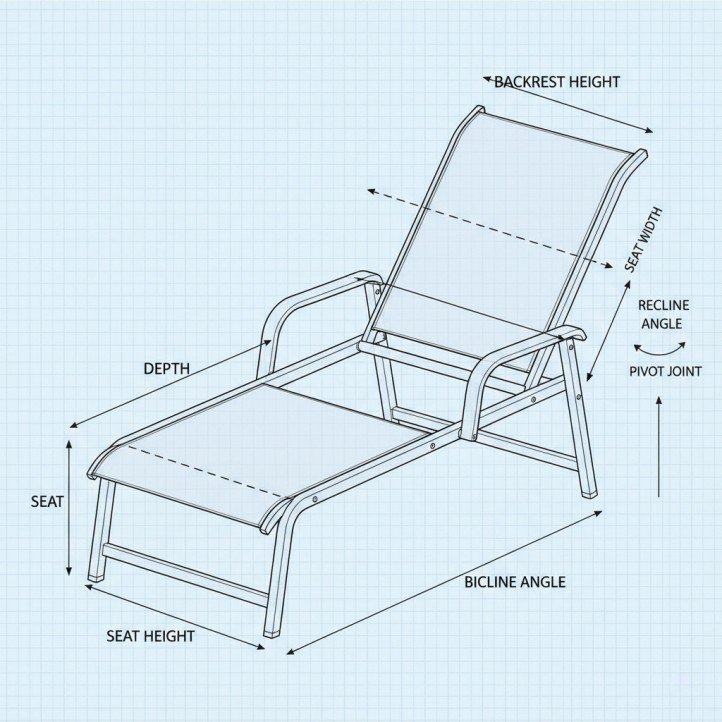
Seat height — the distance from the ground (or footrest) to the seating surface — determines how naturally a user’s knees and ankles align. A well-chosen seat height prevents dangling legs or knee hyperflexion.
- Recommended ergonomic range (indoor consensus): 38–56 cm (15–22 in), with adjustment spans of at least ~11.4 cm. (ANSIHFES100_2007CHAIR CHECKLIST-Cornell University)
- For outdoor chairs, factor in cushion thickness and base frame offset.
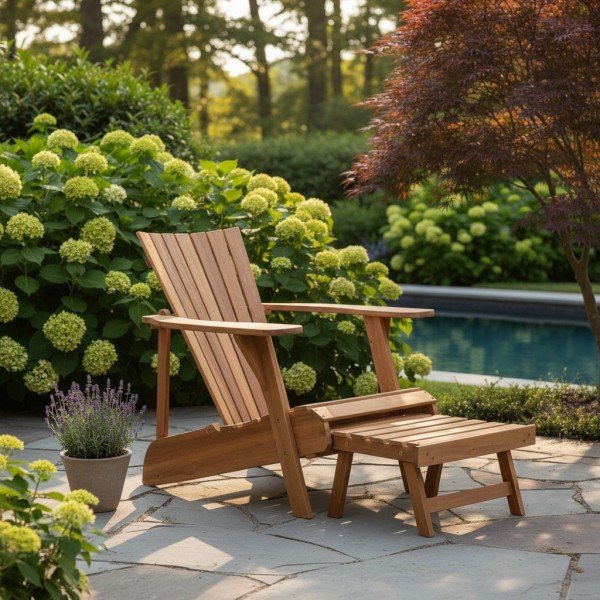
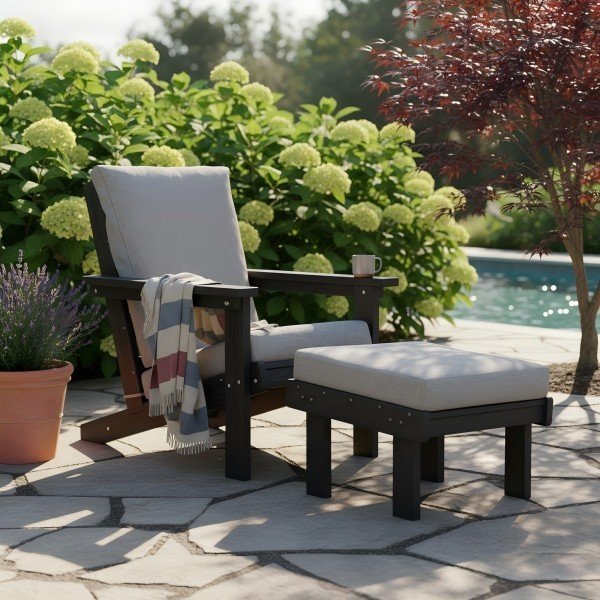
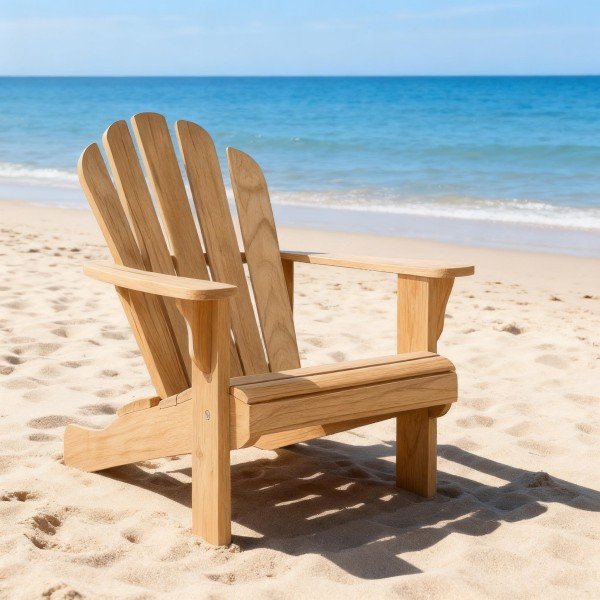
- Example: A Happy Rattan Black Outdoor Teak Adirondack Chair is designed to maintain a user-friendly seat height, even with cushioning. (See product: Black Outdoor Teak Adirondack Chair)
Seat Depth & Contact Surface
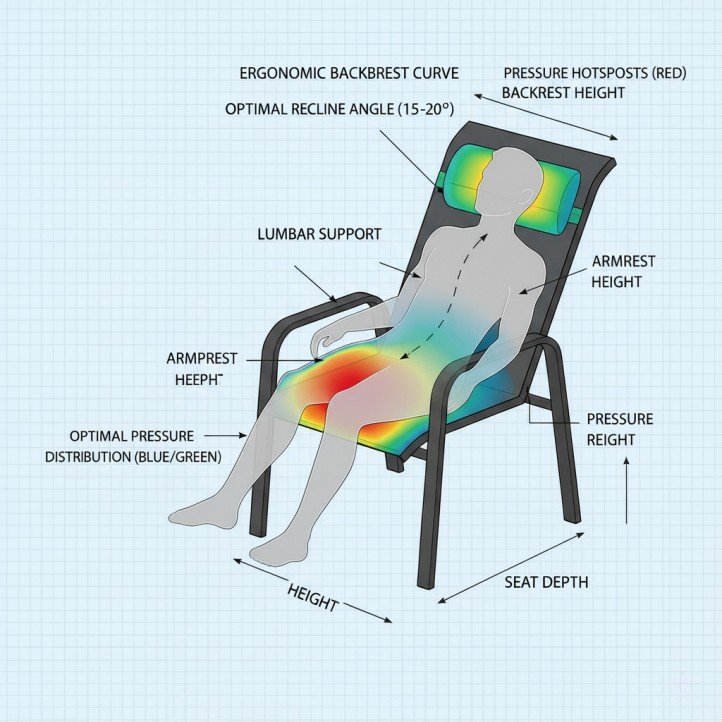
Seat depth (front-to-back) affects how much of the thigh is supported and whether lumbar contact is maintained.
- Too deep → user slides forward or lumbar loses contact
- Too shallow → under-thigh pressure
- A functional range is ~45–55 cm in many ergonomic chairs (but cushion placement may reduce usable depth)
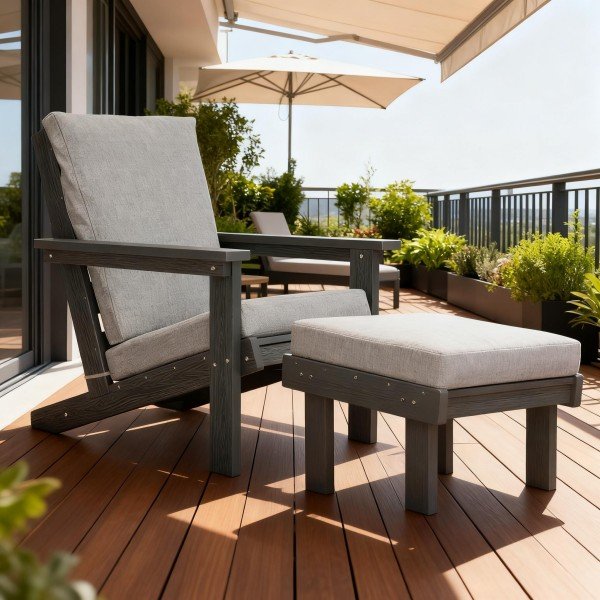
For instance, in the Grey Outdoor Teak Adirondack Chair from Happy Rattan, designers balance depth and padding so that even in reclining modes, the seat and back remain in effective contact. (Product link: Grey Outdoor Teak Adirondack Chair)
Lumbar Support & Back Contour
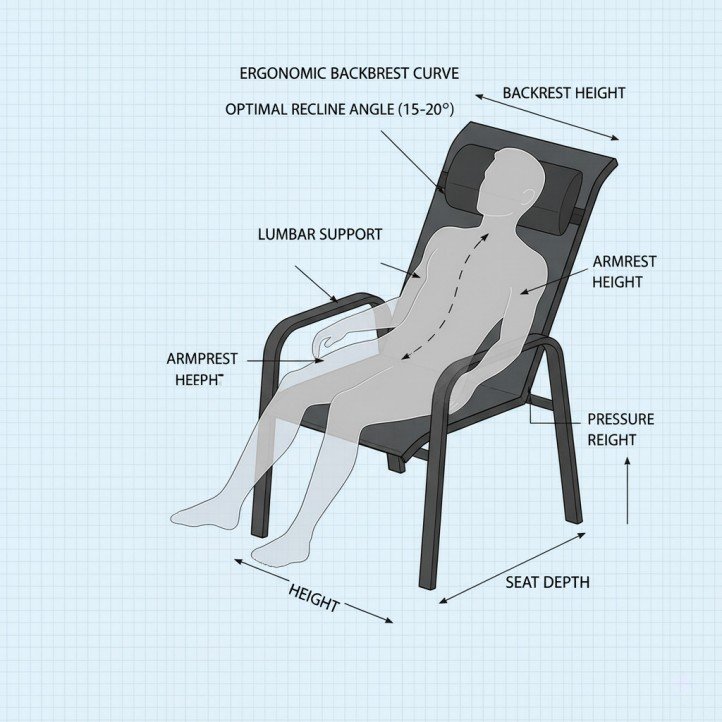
Maintaining the spine’s natural curvature (lordosis) is key to long-term comfort. Chairs often use molded curves, adjustable lumbar pads, or flexible supports.
- In ergonomic literature, chairs should sustain lumbar contact across reclining transitions. (Ergonomic Seating?-Cornell University)
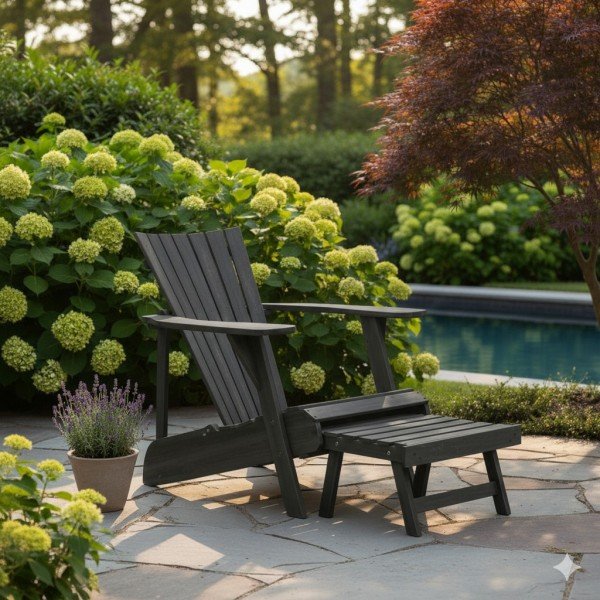
- For example, the Black Plastic Adirondack Chair from Happy Rattan has a contoured back designed to support the lower back even when reclining. (Product link: Black Plastic Adirondack Chair)
Cornell’s ergonomics resources also emphasize that a good chair “tracks where your back is” (i.e., the backrest should maintain contact during recline shifts). (How to choose an ergonomic chair.-Cornell University)
Recline Angle: Biomechanical Core Parameter
The recline angle (angle between the seat plane and backrest) is central to comfort. Supported reclining can significantly reduce disc pressure and muscle activity.
- According to Cornell University’s Ergonomic Seating? guide, a recline angle between 110°–130° yields lowest lumbar stress and muscle activity. (Ergonomic Seating?-Cornell University)
- The same resource states: “Both lumbar disc pressure, back muscle activity, and comfort ratings are lowest with a supported recline angle in the range of 110°-130°.” (
- In practice, many designers treat 100°–115° as a safe “sweet zone” for multi-mode use.
Here is a summary table:
| Recline Angle | Use Scenario | Benefit / Notes |
|---|---|---|
| 100°–105° | Reading / Social | Upright support with slight lean |
| 105°–115° | Rest / Lounging | Balanced lumbar unloading |
| 115°–130° | Relax / Partial Sleep | Minimal disc pressure |
| >130° | Flat / Sunbathing | Full stretch but requires full back & leg support |
Headrest, Armrests & Footrest Integration
- Head/neck support: Adjustable or cushioned headrests reduce cervical strain.
- Armrests: Should sit ~20–25 cm above the seat and not impede reclining motion.
- Footrest/leg extension: Allows full reclining; zero-gravity or synchronized mechanisms that move backrest and footrest in tandem enhance comfort.
Happy Rattan’s Adirondack Chair with Footrest is one example of integrated leg support that adjusts as the back reclines. (Product link: Adirondack Chair with Footrest Outdoor)
Best Recline Angles for Outdoor Use Modes
Reading / Social (~100°–105°)
This mode supports a slight backward lean while preserving upright alignment, making it suitable for reading, socializing, or desk-adjacent use.
Rest / Half-Recline (~105°–115°)
This is often the most frequently used mode: it unloads spinal pressure while maintaining posture support. Chairs designed for this range tend to feel most comfortable for general lounging.
Lounging / Partial Sleep (~115°–130°)
Here, the torso is more open, and leg support becomes more critical. The transition between seat and back must remain continuous; gaps or breaks hurt lumbar support.
Full Recline / Flat (>130°)
Such modes are suited to sunbathing or full recumbency. Only designs with robust legrests, continuous cushioning, and stable frames can accommodate this without discomfort.
Zero-Gravity / Multi-Position Systems
Premium ergonomic outdoor lounge chairs often include synchronized hinge systems, allowing a floating sensation across a wide recline range. Be sure the locking mechanism resists slippage under outdoor conditions.
Procurement Strategies & Selection Criteria
Adjustable Mechanisms & Locking Reliability
- Seek multi-step locking (e.g., every 5°) with smooth, corrosion-resistant pivots.
- Locking mechanisms must remain stable under weight and weather.
- In procurement contracts, require vendors to provide cycle test or lock-slip data.
Material & Frame Durability
- Common materials: teak, powder-coated aluminum/steel, HDPE composites, synthetic wicker.
- Teak & wood remain dominant (wood segment held ~65.70% of revenue share in 2024). (Grand View Research)
- The outdoor furniture market is projected to grow to USD 86.65 billion by 2033. (Grand View Research)
- For instance, Happy Rattan’s teak and composite Adirondack chairs showcase how ergonomic form and durable materials can coexist.
Cushioning, Upholstery & Fit
- Use quick-dry foam, waterproof covers, and UV-resistant fabrics.
- Cushions should remain in firm contact from back to seat, even in reclined modes.
- Removable covers and well-sealed seams reduce maintenance issues.
Portability & Storage
- For seasonal or variable climates, foldable or stackable designs are advantageous.
- Ensure hinges and joints maintain integrity after repeated use.
Budget & Value Balancing
- Entry models may skip reclining detail or lumbar contouring.
- Mid-tier chairs typically deliver the best ROI.
- Premium chairs integrate synchronized motion, higher-grade materials, and refined ergonomics.
Procurement Comparison Table (Illustrative)
| Tier | Recline Mechanism | Material | Key Strengths | Price Range* |
|---|---|---|---|---|
| Entry | Fixed / 2-step | Aluminum / basic | Simplicity, lower cost | $150–300 |
| Mid | 5–7 position | Powder-coated metal + cushions | Adjustable, decent durability | $300–700 |
| Premium | Synchronized / zero-gravity | Teak / high-grade alloys | Seamless comfort, luxury | $700+ |
* Price ranges are approximate and vary by region/brand.
Embedding internal links is key here — for example: [What Is Outdoor Furniture Made Of?].
FAQ (Frequently Asked Questions)
What is the recommended recline angle range for an outdoor lounge chair?
Most ergonomic guidance and biomechanical studies suggest a recline between 100° and 115° strikes an optimal balance between spinal unloading and support. In more relaxed modes, up to 130° may be beneficial depending on design. (See earlier “Recline Angle” section.)
If I have lower back issues, which recline angle is safest?
Users with lumbar sensitivity may prefer staying in the 105°–115° region, where lumbar support can remain continuous. Also, ensure the chair’s lumbar contour is well matched to your spinal curve.
Do fixed-angle chairs suffice compared to adjustable ones?
A fixed-angle recliner can be sufficient for brief lounging, but adjustable and multi-position chairs offer better long-term comfort across different use modes (reading, resting, sunning).
Does the outdoor material (teak, aluminum, wicker) affect comfort?
Yes — materials influence thermal behavior, surface hardness, and structural stability. For example, teak remains cooler under the sun, aluminum dissipates heat faster, and synthetic wicker may trap heat depending on the weave. These factors interact with how comfortable the ergonomics feel under real conditions.
How can I tell if a chair meets ergonomic standards?
Perform these quick checks:
-
Sit and see if your head, back, and legs remain in contact (no gap).
-
Adjust to your preferred recline and see if lumbar support remains consistent.
-
Test across multiple users with varying heights.
-
Review vendor test data or third-party lab reports (e.g., ISO or furniture standard reports).
Conclusion & Procurement Tips — Achieving Long-Term Comfort
Choosing an ergonomic outdoor lounge chair is about more than aesthetics. It’s about matching user biomechanics with structural integrity, adjustability, and materials.
Key Takeaways:
- Focus first on a reliable recline range (100°–115°) with the ability to extend toward ~130°
- Ensure the locking mechanism, hinge reliability, and frame materials are of top quality
- Demand full lumbar, head, and leg support continuity across modes
- Use the checklist below when evaluating suppliers
Procurement Checklist
- Locking mechanism stability & smooth adjustment
- Full ergonomic support (lumbar, head, seamless contact)
- Weather-resistant materials (UV, corrosion, drainage)
- Motion testing (smooth transitions, no catches)
- Warranty, spare parts, and service support
- Real-world reviews, third-party lab reports, or field tests
As a real-world reference, Happy Rattan’s Adirondack chair lines (including Black Teak, Grey Teak, Plastic / Composite models) illustrate how ergonomic design and durable materials can be integrated: