Marine-grade Corrosion Control: How to Specify 316L Stainless for Coastal & Poolside Resort Furniture
Table of Contents
Audience: hospitality developers, contract buyers, FFE/OS&E procurement, and engineering/QA. Goal: help teams select and validate 316L stainless steel furniture systems that truly withstand salt spray and free-chlorine exposure across seaside terraces and pool decks—from alloy choice and surface finishing to testing, RFQ language, and lifecycle cost (TCO).
Coastal aerosols (NaCl) and wind-borne moisture drive pitting and crevice corrosion, while pool chemistry (free chlorine/hypochlorite) accelerates localized attack in warm splash zones. Grade 316L (EN 1.4404) improves resistance versus 304 through molybdenum additions (higher chloride pitting resistance) and lower carbon to mitigate sensitization after welding. See Outokumpu’s corrosion tables and 316L product notes for the Cr-Ni-Mo rationale. (Outokumpu)
To minimize tea staining on exposed architecture near shorelines, align material choice with finishing and maintenance per ASSDA’s coastal guidance. (Australian Stainless Steel Development Assoc.)
Expert POV (fabrication director, hospitality programs): “When specs only say ‘stainless’, early failures spike in the first monsoon season. We standardize on 316L + post-weld passivation and electropolishing near chlorinated water, and we audit drain paths/crevices as aggressively as weld quality.”
(Aligns with Nickel Institute guidance that 316/316L outperforms 304 in pitting/crevice conditions and benefits from good fabrication.) (nickelinstitute)
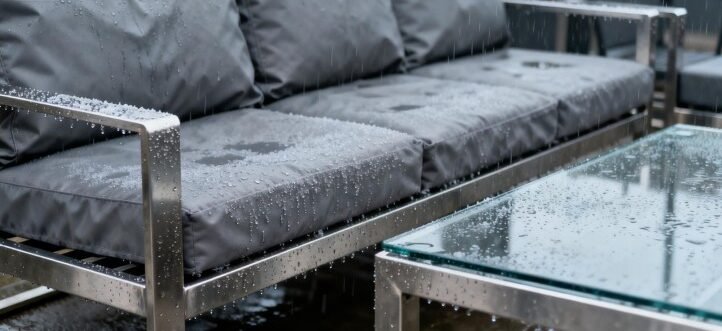
Diagram of chloride exposure causing pitting and crevice corrosion in stainless steel
316L Stainless vs 304 Stainless vs Duplex: what PREN tells you (and what it doesn’t)
PREN (Pitting Resistance Equivalent Number) is a screening metric for localized chloride resistance based on composition: PREN = %Cr + 3.3×%Mo + 16×%N (common form). See the British Stainless Steel Association explainer. (British Stainless Steel Association)
Extra margin in splash zones; consider for fixings/rails where brine entrapment is unavoidable. (Penflex)
*PREN ranks chloride tendency—it is not a life-prediction; confirm with lab tests and site trials.
Surface & fabrication: close the loop from alloy to product
Post-weld acid clean + passivation (citric-based options are common) restores the passive film and removes iron contamination.
Electropolishing (EP) reduces roughness, removes inclusions, optimizes the passive layer, and is repeatedly shown to enhance 316L corrosion behavior in chlorides; see 2024–2025 peer-reviewed studies. (SpringerLink)
Fasteners & washers: call out ISO 3506 A4-70/80 (316-equivalent) classes with compatible washers; mixing grades without isolation elevates galvanic risk. (British Stainless Steel Association)
Galvanic isolation: avoid direct stainless–aluminum or stainless–marine-brass contact; apply insulating bushings/gaskets and manage area ratios per Nickel Institute and IMOA. (Nickelinstitute)
Video supplement:Electropolishing 316 Stainless Steel — Before & After (Able Electropolishing). Why it matters: quick visual of the surface smoothness and passivation improvements procurement/QA should expect on pool-adjacent SKUs.
Testing that belongs in your spec: NSS vs CCT, and reading reports
Table 2 — Comparing common lab methods for procurement specs
Method
Typical aim
Core conditions
Where it fits
ASTM B117 (NSS)
Repeatable comparative screen for coatings/finishes
5% NaCl fog, controlled pH/temperature
Baseline acceptance for hardware/finishes; not a life-prediction. (Q-Lab)
ISO 9227 (NSS/AASS/CASS)
Harmonized salt-spray families
Defined chamber controls & variants
Use when contracts/regions require ISO references. (iso.org)
ASTM G85 / Cyclic protocols
Wet/dry cycles, sometimes modified electrolytes
Alternating sprays/condensation/dry
Better correlation for crevice/pitting in splash zones; run alongside B117/9227. (Assured Testing)
YouTube explainer:Salt Spray Testing (ISO 9227: NSS/AASS/CASS) — clear overview for team training. Why it matters: aligns evaluation criteria and terminology across buyers, labs, and factories.
Scenario-based selection (coastal terrace vs poolside vs splash zone)
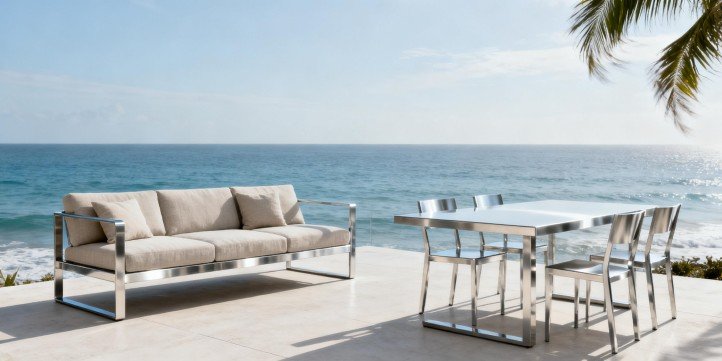
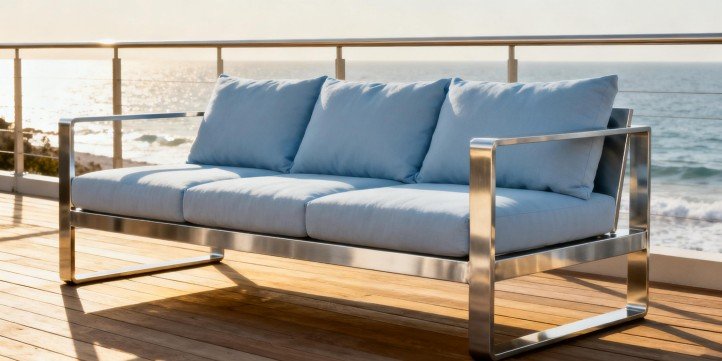
Coastal terrace (ventilated, moderate chloride): 316L with brushed or fine-polished finish + full passivation; eliminate crevices, keep drain paths open. For seating/layout modules, see Outdoor Sofa Collections.
Poolside (free chlorine, warm, frequent splash): prioritize electropolished 316L or high-gloss mechanical finishes; maximize stand-offs from chlorination inlets/overflow lips; enforce rinse protocols—reference typologies via Outdoor Chaise Lounge (Poolside) and planning ideas in the 2025 pool lounger guide.
Direct splash/stagnation zones (fountains/overflow edges): seal welds, oversize weep/overflow holes; consider duplex 2205 for fixings/rails where geometry traps brine. (Penflex)
Shade & dining throughput: align layouts with the Outdoor Dining Set to manage capacity and comfort.
PMI (Positive Material Identification): requires handheld XRF/LIBS alloy verification on frames/fasteners at agreed sampling rates; Thermo Fisher summarizes technology options and trade-offs. (Thermo Fisher Scientific)
Surface metrics: record Ra after finishing; EP typically reduces micro-peaks and inclusion density versus brushed finishes. (SpringerLink)
Cleanliness & contamination control: ban ferrous tool contamination; isolate finishing tooling for stainless.
Maintenance that actually prevents tea staining
Create an SOP that operations can execute without metallurgical expertise:
Rinse cadence: coastal assets: daily to every other day; pool decks: weekly detergent wipe + freshwater rinse; avoid hydrochloric/bleach cleaners on stainless per ASSDA. (Australian Stainless Steel Development Assoc.)
Quarterly: citric passivation gel on hotspots; check drain/weep holes; re-isolate any dissimilar interfaces.
Correct early pits: micro-polish + re-passivate; replace contaminated fasteners.
Frame & hard-parts: 316L (EN 1.4404) with post-weld acid clean + passivation; electropolished finish for pool-adjacent SKUs. Fasteners/washers: ISO 3506 A4-70/80 with insulating washers where mated to dissimilar metals. (British Stainless Steel Association) Testing: third-party lab ASTM B117 (NSS) for baseline + ISO 9227 variant as required; report criteria (not hours only). Add G85/CCT for splash-zone references. (Q-Lab) PMI & inspection: handheld XRF/LIBS verification per lot; report heat numbers, Ra after finish, and weld map. (Thermo Fisher Scientific) Design for durability: sealed welds; drains/weep holes; galvanic isolation per Nickel Institute/IMOA rules. (nickelinstitute)
For bid collation, start from the Products overview, then drill into sofas, loungers, and dining to assemble the pilot set.
Lifecycle cost (TCO): why 316L Stainless wins in 3–5 years
Although 316L carries a material/finishing premium over 304, fewer refurbishments, reduced claim incidence, and less downtime typically yield a favorable break-even within a single asset-refresh cycle in chloride-rich environments; producer handbooks and corrosion tables consistently position 316/316L above 304 for pitting/crevice resistance in chlorides. (Nickelinstitute)
At-a-glance: 316L Stainless selection by scenario (snippet-friendly)
For coastal terraces and pool decks, 316L stainless steel combined with passivation/electropolishing, ISO 3506 A4 fasteners, and NSS + CCT validation delivers predictable performance and a lower 3–5-year TCO. For layout and pilot kits, assemble a test set aligned to exposure class via the Products overview and the category pages above.
References & further reading (embedded above)
PREN method & ranges:British Stainless Steel Association — “Calculation of pitting resistance equivalent numbers (PREN).” (BRITISH STAINLESS STEEL ASSOCIATION)
Hi, I’m Ady, the author of this post. We have 15 years of experience in manufacturing and supplying high-quality outdoor furniture, serving customers in over 30 countries worldwide. From boutique garden designers to large resort chains, our clients rely on us for durable and stylish outdoor furniture that meets international quality standards. Our extensive product range includes rattan sofas, outdoor dining sets, lounge beds, and more, catering to a variety of styles and applications. Whether for hotels, resorts, villas, or private gardens, our furniture is built to enhance outdoor spaces, ensuring comfort, elegance, and long-lasting performance.
If you have any requests, get in touch with us for a free quote and let us provide a one-stop solution for your market.
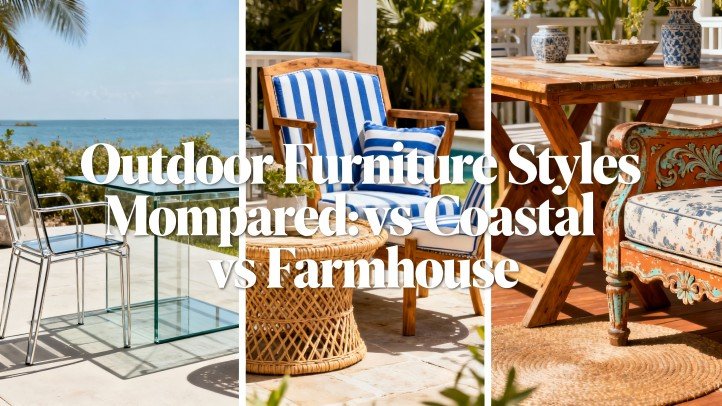
Introduction: This guide-Outdoor Furniture Styles Compared-looks at three favorites-Modern, Coastal, and Farmhouse you can choose with confidence. We cover look-and-feel, common materials,